Answering the essential question for buyers: which car paint thickness meter is best for inspecting used vehicles and spotting non-original coatings? This guide highlights five strong options and explains who each is best for. It covers automatic substrate detection, ease of use, accuracy, and portability to help you compare quickly.
| Product | Best For | Key Advantage | Substrate Detection |
|---|---|---|---|
| Car Coating Thickness Meter for Used Car Buyers (RDINSCOS) | Used car buyers | Automatic steel/aluminum detection | Fe/Al substrates |
| Paint Thickness Gauge CM-205FN for Cars (VVV-Group) | Professional checks | High accuracy, factory calibrated | Fe/NFe automatic detection |
| Mcbazel Paint Thickness Tester Meter Gauge | Budget inspections outdoors | Magnetic tip; no batteries required | Magnetic (general coating) |
| Paint Thickness Gauge CM-224 Auto (VVV-Group) | Multi-panel cars | Fe/NFe/Fe+Zn automatic detection | Fe/NFe/Fe+Zn |
| Reenwee Paint Thickness Gauge | Compact, entry-level use | Auto calibration; data hold | Fe/Al |
Below are five selected products with concise, objective details to help you compare quickly. Each entry includes who it’s best for, why it stands out, and a potential limitation to watch for during use.
Car Coating Thickness Meter For Used Car Buyers
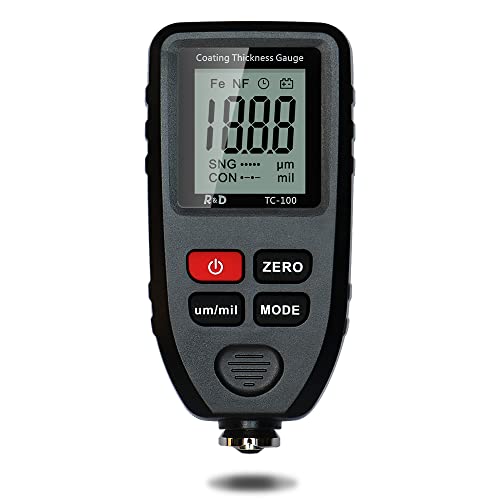
This tool is designed for steel and aluminum substrates with automatic recognition, simplifying measurements on metal surfaces. Best for used car buyers who want to check each panel for hidden repairs. It’s ideal for automotive paint inspection and powder coating checks. The device helps identify inconsistent coatings on panels, doors, and trims. A potential limitation is its primary focus on metallic substrates, limiting use on non-metal surfaces.
Best for: Used car shoppers who want panel-by-panel verification before purchase. Choose this if: you need automatic substrate detection with minimal setup.
Paint Thickness Gauge CM-205FN for Cars

This digital coating thickness meter offers high accuracy with 0.1 μm resolution and ±3%+2 μm accuracy. It supports Fe/NFe automatic detection, making it well-suited for cars with mixed body materials. Its factory calibration and backlit LCD enable quick checks on doors, hoods, roofs, and fenders. Limitation: accuracy depends on correct bonding of the device to the surface; irregular shapes may complicate readings.
Best for: Professional inspections and detailers who require precise, fast readings. Choose this if: you want factory calibration and automatic substrate detection.
Mcbazel Paint Thickness Tester Meter Gauge

This meter uses a magnetic tip and requires no batteries, making it convenient for outdoor use. It provides micrometer-level precision with a color-coded scale for quick readings. Best for buyers who want a simple, battery-free tool on the go. Limitation: may be less versatile for coated non-metal surfaces and some curved panels.
Best for: Quick, battery-free checks on metal surfaces. Choose this if: you need a rugged, outdoor-ready tool with no power requirements.
Paint Thickness Gauge CM-224 Auto

This gauge emphasizes auto-detection for Fe, NFe, and Fe+Zn substrates, useful for vehicles with mixed materials and galvanized panels. It offers a 0.1 μm resolution and out-of-the-box usability with pre-set calibration. Caution: like many entry-to-mid-level meters, extreme surface irregularities may affect accuracy.
Best for: Vehicles with mixed materials and galvanized parts. Choose this if: you need Fe/NFe/Fe+Zn auto-detection for accurate readings across multiple panels.
Paint Thickness Gauge | Reenwee

This compact meter focuses on automatic calibration and data hold, with two units (mm/mil) for flexible reporting. It’s primarily used for non-destructive measurements on car paint. Best for entry-level buyers and mobile inspections. Limitation: may lack some advanced materials detection found in higher-end models.
Best for: Beginners and mobile inspectors who need a compact, easy-to-use tool. Choose this if: you want automatic calibration and a simple interface.
Buying Guide
Key considerations to choose the right car paint thickness meter for your needs:
- Decide if you need automatic detection for Fe (steel) and NFe (aluminum/copper) or if manual mode suffices. Automatic detection reduces user error on mixed-material vehicles.
- Accuracy and resolution: Look for meters with high resolution (0.1 μm or better) and clear accuracy figures. This helps identify repainting and non-original panels more reliably.
- Calibration and ease of use: Factory calibration and data hold features save time during pre-purchase checks. A backlit LCD helps in low-light environments like garage inspections.
- Portability versus capability: Compact meters are convenient for on-site checks, but more advanced models offer multiple modes, graphs, and longer data storage for detailed reports.
- Surface compatibility: Consider the shape and material of vehicle panels. Some meters perform best on flat surfaces; others handle curves and edges well.
- Power and durability: Battery life, auto power-off, and rugged construction matter for frequent field use.
- Budget considerations: Higher accuracy and broader substrate detection typically come at a higher price. Balance needs with cost.
Frequently Asked Questions
- What does a car paint thickness meter measure? It measures the thickness of coatings on metal surfaces, helping identify repainting, repairs, or non-original coatings.
- Why is automatic substrate detection useful? It ensures the correct measurement method is used for different materials, improving accuracy on mixed-material vehicles.
- Can these meters detect galvanized steel? Some models detect Fe+Zn; check product specifications to confirm this capability.
- Is calibration required before use? Some models are factory-calibrated and ready to use; others may require quick calibration steps on first use.
- Which meter is best for beginners? Look for compact designs with simple one-button operation and data hold features.
- How should I interpret readings? Compare readings across panels to identify anomalies. A consistent thickness suggests original coating; large deviations may indicate repairs.