Find the right OBDII code reader and reset tool to diagnose engine trouble codes, clear emissions-related data, and monitor live sensor information. This guide highlights five reliable options and explains who each is best for, with practical tips to help you decide.
The top picks are aimed at DIYers, weekend mechanics, and everyday drivers who want quick diagnostics, clear code definitions, and straightforward user interfaces. The table below summarizes key strengths for quick comparison.
| Product | Best For |
|---|---|
| ANCEL AD310 Classic Enhanced Universal OBD II Scanner | Everyday drivers who want fast DTC read/clear and easy live data |
| FOXWELL NT301 OBD2 Scanner | Users who want enhanced emissions data and VIN retrieval |
| VDIAGTOOL VD10 OBD2 Scanner | DIYers seeking straightforward, no-frills code reading and I/M readiness |
| ANCEL AD410 Enhanced OBD2 Scanner | Users needing broad OBDII functionality with EVAP/O2 sensor testing |
| OBDMATE OBD2 Scanner OM901 | Light-weight, multi-system diagnostics including ABS/SRS/ECM/TCM |
ANCEL AD310 Classic Enhanced OBD II Scanner

The ANCEL AD310 is a best-seller recommended by autobody professionals for quickly determining the cause of a check engine light and clearing diagnostic trouble codes. It reads and clears emission-related codes, shows live data, freeze frame, I/M readiness, and basic vehicle information. It draws power directly from the OBDII port, so no external battery or charger is needed. This model emphasizes speed, simplicity, and reliability for standard OBDII cars.
Best for: everyday drivers who want a compact, reliable tool for fast code reading and clearing without extra setup. It’s a strong choice when you need a straightforward diagnostic pass/fail approach and clear code definitions.
Caution: While the AD310 handles common emissions codes well, it does not substitute for comprehensive professional diagnostics on complex systems.
FOXWELL NT301 OBD2 Scanner

The FOXWELL NT301 provides more than basic code reading. It can read DTCs, check emissions readiness, turn off CEL, and access live data and VIN information. It supports enhanced modes for EVAP and O2 sensor testing. The device is designed to help users verify repairs and assess fuel economy implications from component-level tests. It requires ignition-on to read codes and assumes proper connection to the vehicle’s OBDII port.
Best for: hobbyists or DIYers who want more diagnostic depth, including EVAP and O2 testing, with VIN retrieval for model-specific code lookup. Choose this if you need clearer guidance on what to fix beyond just clearing codes.
Caution: Clearing a code before repairing the underlying issue can cause the code to reappear; ensure repairs are completed before attempting to reset.
VDIAGTOOL VD10 OBD2 Scanner
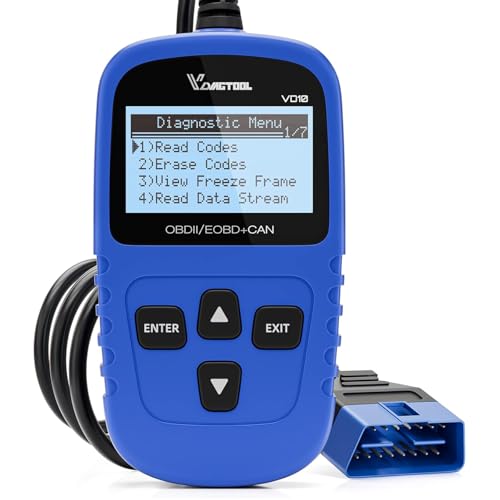
The VDIAGTOOL VD10 focuses on essential DIY diagnostics with read/clear codes, live data, freeze frame, I/M readiness, and vehicle information. It’s an approachable tool for beginners who want a quick scan to identify engine problems and confirm readiness for smog tests. It supports a broad range of OBDII protocols typical of most 1996+ cars, and it emphasizes a fast, plug-and-play experience without the need for updates or a battery.
Best for: new or casual users who want a low-friction start with practical diagnostics and clear DTC definitions, plus immediate I/M readiness status.
Caution: This model centers on engine diagnostics and may not support advanced ABS/SRS/transmission functions found in multi-system tools.
ANCEL AD410 Enhanced OBD2 Scanner

The AD410 emphasizes enhanced OBDII diagnostics, with broad vehicle compatibility and multilingual support. It can quickly read and clear fault codes, provide million-strong DTC lookup data, reset the MIL, and check I/M readiness. It’s powered directly via the OBDII port. Note that it’s a dedicated engine/OBDII tool and does not support ABS, SRS, or some other systems in all vehicle makes.
Best for: users who want a robust engine-focused tool with EVAP and O2 testing features and a large built-in DTC library, suitable for frequent engine diagnostics.
Caution: This device is primarily an engine code reader; it does not reset or diagnose non-engine systems like ABS or airbag modules in all vehicles.
OBDMATE OM901 OBD2 Scanner

The OM901 from OBDMATE offers a multi-system approach. It can reset ABS/SRS/Transmission/Engine lights, read live data, and display Vin. The 3.5-inch TFT screen provides a clear interface, and the device includes a silicone protective case and hard-shell carrying case for durability. It’s plug-and-play with no battery required, designed for quick diagnostics of multiple vehicle systems.
Best for: owners who routinely want cross-system diagnostics, including ABS and SRS, and who value a protective case for portability and durability. Choose this if you want a versatile tool beyond engine-only diagnostics.
Caution: While capable across several systems, it’s still best to verify that it supports your vehicle’s exact modules before relying on it for complex repairs.
Buying Guide
What should you look for when choosing an OBDII code reader?
- Scope of diagnostics: Do you need engine-only or multi-system support (ABS/SRS/Transmission)?
- Live data and data presentation: Do you prefer a simple list, graph views, or VIN retrieval?
- Compatibility: Confirm your vehicle year, make, and model with the device’s supported protocols (CAN, ISO9141, KWP2000, etc.).
- Power and portability: Batteryless units powered via the car port are convenient; consider size and cable length for ease of use in tight spaces.
- Interface and language: Ensure the device supports your preferred language and is easy to navigate for quick results.
- Data lookup and definitions: A built-in DTC library helps translate codes without needing online searches.
- Upgrade and support: Some models offer firmware updates or better software support; factor long-term usability.
Practical decision questions
- Do I mainly need to turn off the check engine light after repairs, or do I want ongoing system monitoring?
- Is VIN retrieval important for your repair workflow and parts matching?
- Do you drive a newer vehicle with EVAP and O2 sensor testing needs?
- Will you use the tool across multiple vehicles or just one car?
- Do you prefer a compact, pocket-sized device or a larger screen with more data visualization?
Quick comparison tips
- Best for simple, fast checks: ANCEL AD310 or VDIAGTOOL VD10.
- Best for enhanced diagnostics (EVAP/O2 tests): FOXWELL NT301 or ANCEL AD410.
- Best multi-system coverage: OBDMATE OM901.
FAQ
- Can I clear codes without repairing the underlying issue? Yes, but codes often reappear if the issue isn’t fixed.
- Do these tools work on all vehicles? Most target 1996+ models with OBDII ports, but always verify protocol compatibility for your car.
- Is VIN retrieval always available? Many models support VIN lookup; check your specific model’s features.
- Do these devices require a battery? Most plug directly into the OBDII port; some may include a battery option or case accessories.
- Can I use these tools for emissions readiness tests? Several models offer I/M readiness checks to help with smog requirements.
- Are aftermarket tools sufficient for professional repair guidance? They provide guidance and diagnostics, but complex issues may still require professional service.