When selecting a side exhaust heat shield, the main goal is reliable heat protection for nearby components while fitting your specific exhaust setup. This guide highlights five top options suited for various environments, from street-legal rides to performance builds. The featured products cover wrap, mat, and shield styles to manage radiant heat, protect hoses and wiring, and reduce under-hood temperatures. Each pick is best for different needs—compact installations, high-heat tolerance, easy mounting, or flexible applications—so you can choose the right shield for your vehicle and usage.
Summary of selected products:
- Titanium Pipe Shield (Racewill Store) — best for high-heat protection in tight spaces.
- FLASLD Aluminized Heat Shield Sleeve — best for adhesive-backed, quick-fit protection on hot ducts.
- LEDAUT Titanium Heat Wrap Roll — best for flexible insulation around curved pipes.
- 12×24 Adhesive Backed Heat Shield Mat — best for flat surfaces needing strong radiant heat reflection.
- Automotive Aluminum Exhaust Heat Shield Wrap — best for universal, high-temp shielding with ties.
Titanium Pipe Shield by Racewill Store
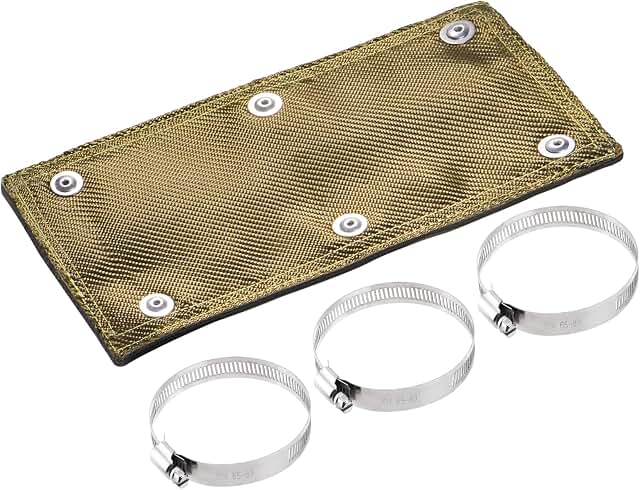
The Titanium Pipe Shield uses a two-layer design with an outer titanium layer and an inner silica fabric, delivering heat protection up to 1350°F. Best for shielding heat-sensitive components, hoses, and electrical wiring when space is limited. Installation is aided by rivet-based standoff brackets and pipe clamps, enabling easier mounting in tight exhaust headers or tight engine bays. A key limitation is the rigid geometry that may require careful fitment on curved pipes. Choose this for high-heat environments where maximum cooling is needed per inch of shield surface.
FLASLD Aluminized Heat Shield Sleeve

This aluminized heat shield sleeve offers adhesive-backed protection up to 2000°F and is designed to cover hoses and ducting. Best for quick, adherent installs on hot runs where a sleeve can conform to contours. It is a solid choice for ductwork or straight sections of exhaust piping. Caution: adhesive performance may vary with extreme temperatures or oily surfaces, and long-term exposure can reduce adhesion in some environments. Choose this if you need a straightforward, wrap-style solution with high-temperature tolerance.
LEDAUT Titanium Exhaust Heat Wrap Roll

The LEDAUT wrap is a 2″ x 50′ roll designed for motorbike and automotive exhaust applications, with fiberglass heat shielding and stainless ties. Best for flexible insulation around long, curved pipes where wrap-form coverage provides thorough radiant heat reduction. It helps lower under-hood temperatures and can reduce heat impact on nearby components. Limitation: wraps may require careful overlapping and securing to prevent unraveling in vibration-prone installations. Choose this for versatile, long sections where a wrap is preferred over rigid shields.
12×24 Adhesive Backed Heat Shield Mat

This aluminized fiberglass thermal barrier mat provides adhesive-backed heat shielding on flat surfaces. Best for engine bays, hoods, and other flat panels that require durable radiant heat reflection up to high temperatures. The mat offers straightforward installation with strong adhesion. Caution: surface preparation is essential for reliable bonding, and irregular shapes may require cutting to fit precisely. Choose this for a low-profile shield on broad, flat areas.
Automotive Aluminum Exhaust Shield Wrap

This shield wrap measures 24 x 12 x 0.4 inches and uses 2000°F-rated fiberglass cotton to reflect about 95% of radiant heat, with 15 metal ties included. Best for universal exhaust shielding on larger sections or mufflers where high heat resistance is required. Better for installations needing robust heat reflection and a simple tie-based securing method. Limitation: bulkier panels may not fit tight spaces or complex bends as easily as flexible wraps. Choose this for broad-area protection on standard exhaust routes.
Buying Guide
What type of heat shield fits your setup?
- Rigid shields: Best for direct coverage of specific components near hot pipes where precise mounting is feasible.
- Wraps and sleeves: Better for curved, long sections and irregular shapes where a wrapped solution can contour to the exhaust.
- Mat and flexible sheets: Ideal for flat panels or larger windows of heat protection with easy adhesive mounting.
Key considerations for selecting a side exhaust heat shield
- Heat tolerance: Verify the shield’s rated maximum temperature to match the exhaust system’s heat output.
- Fitment and shape: Consider space constraints and pipe geometry; some products are better suited for straight runs, others for curves.
- Installation method: Rivets, clamps, adhesive backing, or ties—choose a method that matches your workshop tools and vehicle design.
- Material and durability: Aluminum, titanium, fiberglass, and silica fabrics offer different durability, corrosion resistance, and weight implications.
- Impact on performance: Some solutions reduce heat transfer effectively, while others primarily shield sensitive components. Weigh the need for cooling versus ease of install.
How to compare products quickly
- Best for high-heat exposure: Titanium shields and high-temperature wraps.
- Best for easy install: Adhesive-backed sleeves and mats with straightforward mounting.
- Best for curved sections: Long wraps and flexible sleeves.
- Best for flat panels: Adhesive mats and reflective shields.
Installation tips
- Clean surfaces before applying adhesive-backed shields for reliable bonding.
- Use dedicated clamps, brackets, or ties provided with the product to prevent movement under vibration.
- Test fit before final mounting to avoid clearance issues with belts, hoses, or wiring.
FAQ
- What is a side exhaust heat shield, and why do I need one?
- Can heat shields affect exhaust performance?
- Which material offers the best heat resistance?
- Are adhesive-backed shields reliable for engine heat?
- How do I choose between wrap and a rigid shield?
- Do these shields require professional installation?
A side exhaust heat shield protects nearby components from radiant heat, reduces under-hood temperatures, and can extend the life of hoses and wiring near the exhaust.
Generally, shields do not alter exhaust flow if installed properly. The goal is to redirect heat away from sensitive areas and reduce radiant heat transfer.
Materials like titanium and high-temperature fiberglass or aluminized shields typically offer the highest heat resistance for extreme environments.
Adhesive-backed shields can be reliable on clean, dry surfaces. Surface preparation and airflow around the area influence adhesion longevity.
Choose wrap for curved or long exhaust runs; choose a rigid shield for precise coverage of a known hotspot with simple mounting.
Many shields are designed for DIY installation, but complex exhaust layouts or vehicles with tight tolerances may benefit from professional mounting.