If you’re seeking reliable auto A/C leak sealers that work on both metal and rubber components, these options target refrigerant loss and help protect evaporators, condensers, hoses, O-rings, and gaskets. The top picks below are suited for DIYers and pro shops alike, offering mineral-oil or compatible formulations designed to bond on contact with oxygen under system pressure and seal common leak points. Use this guide to compare which product is best for your vehicle and leak type.
| Product | Best For | Key Benefit |
|---|---|---|
| BlueSeal A/C Stop Leak (Non-Polymer, R-1234yf) | Owners of R-1234yf systems needing metal & rubber seal | High seal rate, bonds quickly, USA-made |
| BlueSeal Quick A/C Cold Boost (R134a) | R134a systems requiring quick cooling and leak sealing | Improves cooling, seals both metal & rubber |
| BlueSeal A/C Stop Leak (Non-Polymer, R-134a) | R-134a systems with multiple leak points | Lab-tested stability, seals evaporators, hoses, O-rings |
| Leak Saver Direct Inject AC Leak Sealer | Various HVAC systems up to 5 tons | Permanent seal and preventative protection |
| Blueseal R134a A/C Stop Leak with UV Dye | DIYers wanting UV-detectable sealant | Lab-backed 95%+ seal rate, UV dye feature |
BlueSeal A/C Stop Leak, Non-Polymer, R-1234yf

Best for vehicles with R-1234yf systems that lose refrigerant through metal and rubber joints. The non-polymer mineral oil formula is designed to bond on contact with oxygen under system pressure, sealing evaporators, condensers, hoses, gaskets, and O-rings. It is made in the USA and is noted for not clogging expansion valves or recovery equipment. Suitable for shops and DIYers, it aims to seal dried or aging seals and addresses leaks at common points. A potential limitation is that performance claims are tied to systems losing 25 ounces or less annually, so larger, ongoing leaks may require additional service.
Best for: R-1234yf automotive A/C systems with metal/rubber leaks, DIY enthusiasts and small repair shops.
Why it was selected
- Non-polymer mineral oil approach reduces risk of clogging sensitive valves.
- Made in USA with test-backed seal performance.
- Targets multiple leak points including evaporator cores and O-rings.
Limitations
Effectiveness is described for leaks within an annual loss of 25 oz or less; may require professional diagnostic for larger leaks.
BlueSeal Quick A/C Cold Boost R134a Stop Leak Sealant

This option is tailored for R134a systems and emphasizes an all-in-one approach that adds cleaning and lubrication to improve Freon flow and cooling performance. It seals metal and rubber leaks and includes a reusable recharge hose. It claims 95%+ effectiveness on systems with capped annual refrigerant loss under 25 oz. Best for users who want a simple, one-step solution with a potential cooling improvement. Consider this as a dual-purpose product when you want an extra boost in performance alongside leak sealing.
Best for
R134a systems needing not only leak sealing but also enhanced cooling and Freon flow.
Notes
Includes a reusable hose for convenient use; effectiveness is tied to cases with modest refrigerant loss.
BlueSeal A/C Stop Leak, Non-Polymer (R-134a)

Designed for R-134a systems, this non-polymer mineral oil formula bonds on contact with oxygen and seals common leak points such as evaporator cores, condensers, hoses, gaskets, and O-rings. It’s made in the USA and targets dried or aging seals. The same caveat applies: results are presented for systems with relatively small annual refrigerant losses (25 oz or less). It’s a straightforward choice for residents with older R-134a vehicles or DIY conservations of refrigerant.
Best for
R-134a car A/C systems needing a reliable, non-polymer sealant for metal and rubber components.
Limitation
Performance claims assume modest annual leaks; larger leaks may require professional assessment and service.
Leak Saver Direct Inject AC Leak Sealer
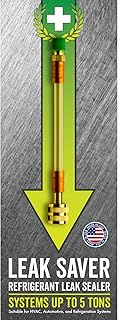
Leak Saver targets multiple HVAC systems, including cars, central air, refrigerators, and mini-splits, up to 5 tons. It claims permanent sealing of small leaks when refrigerant loss is not rapid, using a direct-injection approach that avoids syringes and hoses. It is compatible with a wide range of refrigerants, including R134A, R1234yf, and others, though automotive setups may require a standard 134A to 1/4” charging adapter. This makes it suitable for multi-system use and preventive maintenance. A potential limitation is the need for compatible charging adapters and basic manifold gauge skills for installation.
Best for
Home technicians who service multiple HVAC systems and want a universal solution with preventive benefits.
Blueseal R134a A/C Stop Leak with UV Dye

This option adds a UV dye component to the stop-leak formula, allowing users to visually identify leaks with UV light. It is a zero-polymer, non-hazardous, USA-made product designed for MVAC automotive systems. The 95%+ seal rate has lab backing for systems losing 25 oz of Freon or less annually. The dye helps pinpoint leaks for future maintenance and rechecks. Consider this for easier leak detection alongside sealing capability.
Buying Guide
What to consider when choosing an auto A/C leak sealer:
- System type and refrigerant: Ensure the product is compatible with your refrigerant (R-1234yf, R-134a, etc.) and system type (car, mini-split, etc.).
- Seal points addressed: Look for formulas that target evaporators, condensers, hoses, O-rings, and gaskets.
- Formulation type: Non-polymer mineral oil vs. polymer-based; consider potential clogging risks and valve compatibility.
- Annual leak expectation: Many claims are based on leaks up to 25 oz per year; larger or persistent leaks may require professional service.
- Detectability: UV-dye variants help locate leaks during future maintenance.
- Installation practicality: Some products use direct injection, while others require mixing with the refrigerant charge; check your toolkit compatibility.
- USA-made and lab-backed testing: These factors may indicate consistent formulations and quality control.
How to use safely and effectively
Follow label instructions carefully. Ensure the system is at recommended pressures and temperatures before introducing any sealant. If a leak persists after application, consult an HVAC professional to prevent refrigerant loss or compressor damage.
FAQ
- Do these sealers work on all automotive A/C systems? Most are designed for common passenger vehicles; check your refrigerant type and system compatibility.
- Can I use sealant with a refrigerant recovery system? Yes, but avoid clogging specialized equipment; follow manufacturer guidance and local regulations.
- Will sealants fix large leaks? They generally target small, slow leaks. Large or active leaks may require repair and part replacement.
- Is UV-dye helpful for future leaks? Yes, UV-dye helps locate leaks during service checks after sealing.
- Are these products safe for rubber and metal components? Most are formulated to be safe for common A/C materials, but always verify material compatibility for your vehicle.
- Should I replace aging seals first? Sealing is often more effective after diagnosing root causes and replacing severely worn components when needed.