The buyer’s search is typically for durable, straight-through 4″ mufflers that maximize exhaust flow while providing a deep, resonant sound. This guide highlights five well-suited options for diesel trucks and heavy-duty vehicles, focusing on straight-through designs, stainless steel durability, and universal compatibility. Each product is described with who it’s best for, its key features, and practical considerations. A quick comparison table is included to help you decide faster.
Product Comparison
- Upower 4″ Inlet Diesel Exhaust Muffler — Best for heavy-duty diesel fleets seeking durable welded-on construction.
- EVIL ENERGY 4″ Resonator Muffler — Best for daily drivers needing a balanced, deep tone without excessive complexity.
- LCGP 4″ Inlet Diesel Exhaust Muffler — Best value for a durable, straight-through stainless option.
- 4 Inch Diesel Muffler Exhaust (JFKAI QIANG) — Best for trucks needing precise dimensions and a polished finish.
- 4 Inch Inlet Diesel Muffler with Clamp (JY PERFORMANCE) — Best for TIG-welded, polished, easy-install setups.
Upower 4-Inlet Diesel Exhaust Muffler

Best for heavy-duty diesel fleets that require long-lasting welded-on durability. This muffler features a 4″ inlet and outlet, a 30″ overall length with a 24″ body, and a straight-through design to minimize exhaust backpressure. The stainless steel construction delivers lifelong protection, while CRF (Continuous Roving Fiberglass) tech helps reduce interior resonance. Choose this when installation longevity and consistent exhaust flow are priorities. A limitation is its size; ensure compatible mounting space on your chassis.
EVIL ENERGY 4-Inch Resonator Muffler
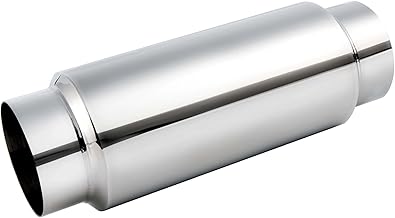
Best for daily drivers and mid-range use where a balanced, deep tone is desired. This muffler uses a 4.0″ OD inlet/outlet with a compact 13.7″ overall length and a 4.53″ body diameter. Made from 201 stainless steel housing with 430 stainless steel inner mesh, it offers straightforward universal fit for compatible exhaust systems with sufficient install space. A caveat is its shorter length, which may yield a different sound profile on longer exhaust runs compared to longer models.
LCGP 4-Inch Inlet Diesel Exhaust Muffler

Best value for a durable stainless steel option with a clear straight-through design. This unit features a 30″ overall length, 24″ body length, and a 7″ round body width. It emphasizes stainless steel construction for long-lasting anti-rust reliability and improved life span. It’s a strong all-around choice for builders prioritizing a straightforward install and solid longevity. The limitation to consider is that it’s a universal muffler, so the fit must be verified against your vehicle’s mounting points.
4 Inch Diesel Muffler Exhaust (JFKAI QIANG)

Best for trucks needing precise, easy-fit dimensions and a polished look. It offers a 4″ inlet and outlet, a 7″ wide by 24″ long muffler body, and a total assembled length of 30 inches. Constructed with stainless steel to resist corrosion, it presents a clean, professional finish. The selection note is to confirm compatibility with your vehicle’s undercarriage and mounting hardware since universal parts vary in fit.
4 Inch Inlet Diesel Muffler With Clamp — JY PERFORMANCE

Best for TIG-welded, polished installations requiring a secure, visually clean finish. This 7″ round by 24″ body muffler with a total length of 30″ is designed for straight-through flow and rust resistance thanks to stainless steel construction. It comes with a clamp-ready setup for straightforward installation. A limitation is that some trucks may require custom mounting brackets or additional hardware for a perfect fit.
Buying Guide
- Design and flow: Straight-through mufflers promote higher exhaust velocity and less backpressure, which can improve engine efficiency and tone. Consider the vehicle’s engine type and typical operating load when selecting a unit.
- Materials: Stainless steel (especially in high-quality 304/316 grades) resists rust and corrosion, extending lifespan in harsh environments. Welded-on resonators typically offer superior durability over bolt-on components.
- Size and fit: Confirm inlet/outlet diameter, body length, and overall length. Ensure the muffler fits within the vehicle’s undercarriage with enough clearance for mounting hardware and heat shields.
- Sound profile: Longer mufflers generally produce a deeper tone, while shorter units can yield a brighter or more aggressive sound. If sound level is a concern, review the tone description and, if possible, audio samples.
- Installation considerations: Welded-on designs are permanent and require fabrication for mounting in some vehicles, while clamp-on variants may simplify installation but could require periodic checks for leaks.
- Compatibility: If the exhaust system is not standard, verify that the chosen muffler is suitable for your pipe diameter (4″ in/out in this case) and will align with existing brackets and hangers.
FAQ
- Q: What is the main advantage of a straight-through muffler?
- A: It reduces backpressure and can improve exhaust flow, potentially enhancing engine efficiency and providing a deeper exhaust tone.
- Q: Are 4″ mufflers universal for all diesel trucks?
- A: Many 4″ mufflers are universal, but fit depends on space, mounting points, and pipe diameter. Check dimensions and compatibility before purchase.
- Q: Is stainless steel necessary for longevity?
- A: Stainless steel offers superior resistance to rust and corrosion, which is beneficial for vehicles exposed to salt, moisture, or harsh climates.
- Q: Should I choose a welded-on or clamp-on muffler?
- A: Welded-on units tend to be more durable and leak-resistant, while clamp-on units allow easier installation and removal, but may require sealing during use.
- Q: How can I ensure a proper fit on a diesel pickup?
- A: Measure the available undercarriage space, confirm inlet/outlet diameters, and compare body length and mounting locations with the muffler’s specifications.
- Q: Will a longer muffler always sound deeper?
- A: Not always; volume and tone depend on the entire exhaust system layout, including piping, resonators, and engine tuning.