When your car won’t start, the right set of jump cables can be a lifesaver. This guide highlights five durable jumper cables and jump starter kits that are well-suited for a range of vehicles, from compact cars to SUVs and light trucks. Whether you need heavy-duty booster cables for a dead battery or a portable jump box with extra lighting, these picks are chosen to help you decide quickly. The top buyers are motorists who want strong bending resistance, clear color-coding, and easy storage.
Summary table of selected products:
| Product | Best For | Key Benefit |
|---|---|---|
| Energizer Jumper Cables for Car Battery (16-ft, 6-gauge) | Everyday drivers with mid-size batteries | Heavy gauge for reliable jumps |
| TOPDC 4 Gauge 20 Feet Jumper Cables | Large vehicles needing longer reach | Excellent length with sturdy insulation |
| NOONE Jumper Cables for Car Battery (10-ft) | Compact cars and emergency kits | Compact, portable with solid conductors |
| AUXITO 6000A Jump Starter | Portable power on-the-go | All-in-one jump starter with LED and case |
| 7000A Jump Starter (8000mAh) | All-gas and diesel engines needing strong boost | High power with flashlight |
Energizer Jumper Cables for Car Battery

The Energizer jumper cables are a heavy-duty option designed for reliable jumps with standard automotive batteries. The 16-foot length provides ample reach for near-vehicle or curbside positioning, while the 6-gauge construction supports robust current transfer. Best for drivers who regularly encounter weak or dead batteries and want sturdy, reusable cables that resist heat buildup during a jump.
Who it’s best for: everyday drivers with mid-size cars and light trucks who need dependable performance in variable conditions. Why selected: strong gauge and proven durability for frequent use. Caution: longer cables can be heavier to handle, so store with care in a bag or rack.
TOPDC 4 Gauge 20 Feet Jumper Cables
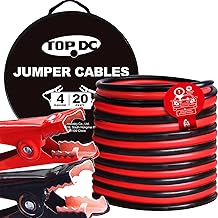
TOPDC offers a longer reach with a 20-foot cable pair and a 4-gauge conductor. This combination is advantageous for working on larger vehicles or when the jumper cables cannot be placed directly adjacent to the battery. It includes a carrying bag for easy storage. Best for drivers who need extra length and better flexibility during a jump, especially in limited space or crowded garages.
Who it’s best for: SUV and light truck owners who require distance flexibility. Why selected: the extra length extends your options for positioning the assisting vehicle. Caution: 4-gauge copper conductors are robust but can feel stiffer during setup when compared to thinner options.
NOONE Jumper Cables for Car Battery (10-ft)

NOONE’s 10-foot jumper cables offer a compact, lightweight option suitable for smaller vehicles or emergency kits. The 10-foot reach gives enough space for a typical parking scenario, while strong conductors support efficient power transfer. Best for: drivers prioritizing portability and quick access in compact cars. Limitation: shorter length may limit placement options in tight spots or with larger batteries.
AUXITO 6000A Jump Starter

AUXITO’s 6000A jumper starter combines a high-current boost with a 12V system and an integrated LED display. It supports most gasoline engines and some diesel engines, and it includes a portable case. Best for users who want an all-in-one solution with an easy-to-read display and built-in media lighting for roadside needs. Choose this if you need a compact, multi-function jump starter rather than traditional cables alone. Caution: subcompact cars may not use the full rated start capacity every time; verify engine size alignment.
7000A Jump Starter (12V)

The 7000A Jump Starter combines high starting power with a 800 Lumen flashlight for roadside illumination. It supports most gas engines and up to 12L diesel engines, making it a robust choice for larger or older vehicles. Best for those who want a strong boost with emergency lighting and a portable case. Choose this if you anticipate needing a jump starter in low-light conditions. Caution: the unit is powerful—handle with care and follow safety instructions to avoid improper use.
Buying Guide: Key Considerations For Cable Jumpers For Cars
What should you look for when choosing jumper cables or a jump starter? Consider gauge and length, insulation quality, portability, and the intended vehicle size. Heavier gauge (lower number) cables carry more current, which is important for larger engines. Longer cables provide flexibility in cramped parking or when the assisting vehicle cannot be placed close to the battery. For portable jump starters, check peak amperage, battery compatibility, built-in protections, and included accessories like cases or LED flashlights. Storage and ease of handling matter for regular use.
Gauge, Length, And Flexibility
Look for at least 6-gauge cables if you regularly jump mid-size or larger engines. For compact cars, 8- to 10-gauge may suffice, but longer lengths (15–20 feet) improve positioning in constrained spaces. Cables with robust insulation resist heat and cracking after repeated use. A carrying bag or case helps keep everything organized in the trunk or garage.
Safety Features And Portability
Prioritize cables with color-coded clamps and clear polarity labeling. Some jump starters include overload protection, spark-proof clamps, and reverse polarity alarms. For portability, a compact case and lightweight construction make it easier to transport and store.
All-In-One Jump Starters vs. Cables
All-in-one jump starters provide independent power and can start engines without another vehicle. They’re convenient for frequent travelers or those who park in isolated areas. Traditional jumper cables paired with a separate power source can be more cost-effective and simple, but require another vehicle’s battery to jump.
Vehicle Compatibility And Use Cases
Assess whether your typical use involves small cars, SUVs, or diesel trucks. For diesel engines, higher peak amperage and robust cables help ensure successful starts. In contrast, everyday commuters may be well-served by a reliable 16-foot, 6-gauge configuration for versatile placement.
Maintenance And Longevity
Inspect clamps for corrosion resistance and wire flexibility. Keep cables dry and clean; replace frayed or damaged cables promptly to avoid safety hazards.
Frequently Asked Questions
- What is the difference between jumper cables and a jump starter?
Jumper cables connect two batteries to transfer power, while a jump starter provides its own power to start the engine, often in a compact unit with additional features. - What gauge should I choose for a mid-size car?
6-gauge cables are common for reliable performance; 4-gauge is preferred for longer lengths or more demanding starts. - How long should jumper cables be?
15 to 20 feet is typical for flexibility; shorter cables are easier to manage but limit placement options. - Are portable jump starters safer than jump cables?
Jump starters reduce dependency on another vehicle and often include safety features, but proper use and charging are essential. - Can I use jumper cables on a diesel vehicle?
Yes, but ensure the cables and jump starter meet the engine’s higher amperage requirements and follow safety guidelines. - What should I do after a successful jump start?
Keep the engine running for a while to recharge the battery, and consider replacing or testing the battery and alternator if failures persist.