Choosing a reliable 2-bank marine battery charger ensures your boat’s batteries stay charged, balanced, and ready for every voyage. This guide highlights top 2-bank models, comparing features like charging modes, waterproofing, and compatibility with lead-acid and lithium batteries. Each product below is evaluated for marine reliability, safety features, and ease of use, helping you pick a charger that fits your vessel and power needs.
The following quick-reference table summarizes the selected products, focusing on 2-bank configurations and key capabilities.
| Product | Bank Count | Total Current | ||
|---|---|---|---|---|
| NOCO Genius GEN5X2 | 2 | 10A | Lead-Acid & Lithium | Waterproof (marine) |
| FirstPower Pro 5X2 | 2 | 10A | Lead-Acid & Lithium | IP68 Waterproof |
| Smart 2 Bank Marine Charger (Zrfmib) | 2 | 10A | Lead-Acid & Lithium | Waterproof design |
| SOARFLY 2 Bank Marine Charger | 2 | 10A | Lead-Acid & Lithium | Waterproof |
| LiTime 2-Bank 10A | 2 | 10A | LiFePO4 & Lead-Acid | IP65 Waterproof |
NOCO Genius GEN5X2: 2-Bank 10A Onboard Charger
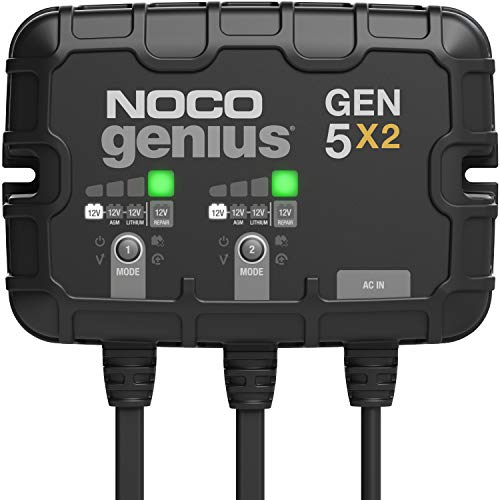
NOCO GEN5X2 delivers two independently controlled charging banks with a combined 10 amps (5 amps per bank). It is designed for marine use, offering a compact form factor that fits tight bilge spaces while standing up to harsh conditions. The charger supports multiple modes for each bank, including 12V, 12V AGM, 12V Lithium, and a Repair Mode. This versatility helps maintain a broad range of battery chemistries, from traditional lead-acid to advanced LiFePO4 batteries, with precise regulation to prevent overcharging and maximize battery life.
Key features include temperature compensation to adapt charging to ambient conditions and overcharge protection to safeguard both the battery and electrical system. Its waterproofing level is suitable for marine environments, helping resist moisture exposure common on boats. The GEN5X2’s compact size makes installation feasible in tight compartments, while its independent bank operation allows different battery types to be charged simultaneously without cross-interference.
Typical applications include sailboats, powerboats, fishing boats, and yachts that rely on dual battery banks for starting and house loads. For owners upgrading from a single-bank charger, the GEN5X2 provides a straightforward path to efficient two-bank operation with flexible charging profiles.
FirstPower Pro 2 Bank 5X2: 10A Marine Charger

The FirstPower Pro 5X2 provides two independent charging channels totaling 10 amps (5 amps per bank). It is designed to handle both SLA/AGM and lithium-type batteries, including LiFePO4, with IP68-rated waterproofing for durability in wet environments. Its dual-mode capability allows each battery to be set to the appropriate charging profile, ensuring compatibility with a mix of battery chemistries on the same vessel or across multiple circuits.
Mode selection is accessible via a simple control interface, enabling separate configurations per bank. The charger also includes a Force Mode feature to recover deeply discharged cells by initiating charging when voltage is very low, which can extend battery life by reviving stubborn cells. This model’s rugged waterproofing makes it suitable for deck installation in exposed locations, while its compact footprint supports installation in cramped bilge or cockpit compartments.
Ideal for motorboats, cruisers, and fishing vessels that require reliable dual-bank charging with flexible chemistry support and straightforward operation. It’s a practical upgrade for users seeking 2-bank performance without the higher current draw of faster chargers.
Smart 2 Bank Marine Charger by Zrfmib

The Zrfmib Smart 2 Bank Marine Charger offers two independent outputs at 5A per bank, totaling 10A. It supports 12V SLA/AGM, 12V Lithium, and 12V Calcium modes, enabling simultaneous charging of two batteries with mode selection tailored to each battery’s chemistry. The design emphasizes automatic transition from charging to float mode to maintain full charge without overcharging, a key consideration for boats left connected to power for extended periods.
Dead-battery recovery is addressed via a Force Mode that allows users to start charging when a battery voltage is under 1V. Waterproof construction simplifies mounting in exposed areas, and the unit is suitable for marine, RV, and other 12V applications requiring dependable two-bank operation. The product supports mixed battery configurations on the same vessel, reducing the need for separate chargers for each bank.
This charger provides a budget-friendly, versatile option for boaters who need reliable dual-bank performance with flexible mode options and robust protection features in a compact package.
SOARFLY 2 Bank Marine Battery Charger

SOARFLY’s 2 Bank Marine Battery Charger delivers 10A total (5A per bank) for 12V systems, with compatibility across lead-acid (SLA/AGM/Calcium) and lithium (LiFePO4) batteries. It features three charging modes to accommodate different chemistries and allows two batteries to charge concurrently. A dedicated Force Mode enables charging of deeply discharged batteries, reviving cells that have dropped below 1V.
The charger is designed for marine use, offering a waterproof build that withstands typical deck exposure. Independent mode selection per bank lets boat owners optimize charging for different battery types on start and house circuits. The device’s compact footprint makes it suitable for installation in crowded engine rooms, dash areas, or locker spaces on various boat types, from sailboats to small fishing vessels.
For boaters seeking a cost-effective, reliable two-bank solution with practical protection features and dead-battery recovery, this model provides a straightforward option without sacrificing essential performance.
LiTime 2-Bank 10A LiFePO4 Charger
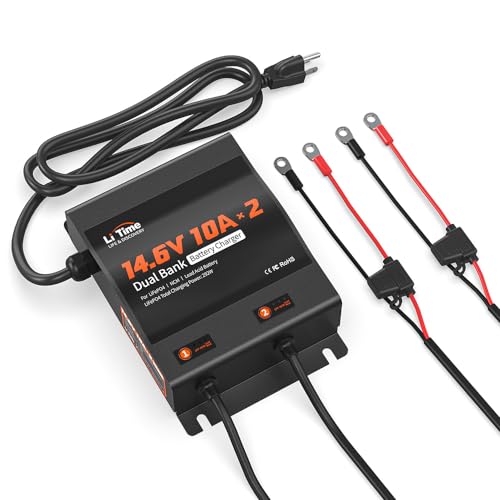
The LiTime 2-Bank 10A charger provides two independent channels at 10A total per bank (10A per bank). It supports LiFePO4 batteries as well as traditional lead-acid chemistries, making it a versatile choice for mixed setups. Rated for 90V-260V AC input, it includes safety features such as fusing and multiple protections against over-temperature, over-current, reverse polarity, short circuits, and over-voltage. The device carries IP65 waterproof certification, suitable for outdoor or exposed installations on a boat.
With a dedicated 14.6V charging voltage for LiFePO4 cells, this charger aims to optimize lithium performance while maintaining compatibility with lead-acid systems. The dual-bank design and robust protections make it a solid option for boat owners seeking reliable, long-term battery upkeep for both starting and auxiliary power needs on a marine vessel.
Buying Guide: Key Considerations for Choosing a 2-Bank Marine Battery Charger
- Battery compatibility: Ensure the charger supports your battery chemistries (lead-acid, AGM, calcium, and lithium LiFePO4). Some models offer explicit dual-mode per bank to accommodate mixed chemistries.
- Current and bank balance: A 2-bank charger with 5A per bank (total 10A) is suitable for most smaller boats; higher current options (e.g., 10A per bank) exist for larger boats with more demanding starting and house loads.
- Waterproofing and marine rating: Look for IP ratings or marine-specific waterproofing to withstand steering compartments, bilges, and exposed deck areas. This reduces risk from splashes and humidity.
- Mode options and recovery features: Select chargers with multiple charging modes to tailor the charge to battery type. A Force Mode or dead-battery recovery feature can extend battery life by reviving deeply discharged cells.
- Size and installation: Compact form factors help fit into tight engine rooms or dash panels. Check mounting options and connector types for a clean, secure installation.
- Safety protections: Thermal compensation, overcharge protection, reverse polarity protection, and short-circuit protection prevent damage to batteries and electronic systems.
- Technology and maintenance: Some chargers include built-in desulfation or maintenance features, which can be beneficial for long-term battery health on boats left connected to shore power for extended periods.
- Warranty and support: A solid warranty and accessible customer support can be valuable given the harsh marine environment and potential for corrosion or moisture exposure.
- Cost of ownership: Consider long-term energy efficiency, maintenance needs, and compatibility with future battery upgrades (e.g., transitioning from lead-acid to LiFePO4) when evaluating upfront price.
Across these options, two-bank chargers deliver the essential capability to manage separate starting and auxiliary batteries while keeping care for multiple battery chemistries in mind. Boaters should align charger features with their vessel size, electrical load, and planned battery upgrades to ensure reliable performance on every voyage.