Choosing the right 4-channel car amplifier involves balancing power, efficiency, input options, and cooling. This guide highlights five top options with solid performance, reliability, and flexible features for a range of systems—from budget builds to high-fidelity installs. Each model is evaluated on output capability, inputs, and crossover options to help you pair the amplifier with your speakers for a well-rounded car audio experience.
| Product | Brand | Key Power (approx.) | Notable Features |
|---|---|---|---|
| Taramps TS 400×4 | Taramp’s | 100W x4 @2Ω; 200W x2 @4Ω | 2Ω stability, high-level + RCA inputs, built-in crossovers |
| Alpine S-A32F | Alpine | 55W x4 @4Ω; 80W x4 @2Ω | Clean Class D efficiency, compact size |
| Skar RP-75.4AB | Skar Audio | 75W x4 @4Ω; 125W x4 @2Ω | Class A/B, solid power for four channels |
| BOSS R1004 Riot | BOSS Audio Systems | 50W x4 @4Ω; 100W x4 @2Ω | Low/high level inputs, full range |
| Orion Cobalt CBA2500.4 | ORION | 2/4 Ω up to 2500W total | MOSFET, low/high inputs, robust design |
Taramp’s TS 400×4 Black Car Audio Amplifier

The Taramp’s TS 400×4 is a versatile 4-channel Class D amplifier rated at 400W RMS total. Each channel delivers up to 100W at 2 ohms, with two channels bridgeable at 200W each at 4 ohms for flexible system configurations. It offers dual input options: high-level inputs that automatically activate and traditional RCA inputs for compatibility with various head units. A built-in crossover provides fixed high-pass and low-pass filters around 90 Hz, plus a full-range option and precise gain control for tuning. This makes it suitable for multi-speaker setups and moderate subwoofer integration.
Alpine S-A32F 4 Channel Amplifier

The Alpine S-A32F is a compact 4-channel amplifier delivering 55W per channel at 4 ohms and 80W per channel at 2 ohms. Designed for efficiency and clean amplification, this model is well-suited for upgrading factory audio or powering a modest mid/high speaker system. Its reputation for reliable performance and low heat output makes it a strong choice for space-constrained builds where sound quality is prioritized over raw power.
Skar RP-75.4AB 500W 4-Channel Class A/B
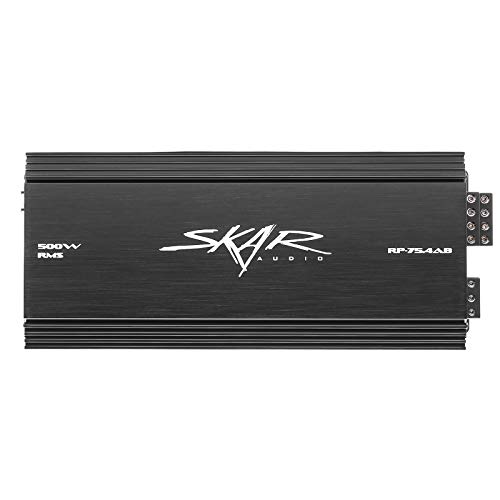
The Skar RP-75.4AB delivers 500 watts total power with a Class A/B topology. At 2 ohms, it provides 125W per channel, and at 4 ohms, 75W per channel. This makes it capable of powering a complete four-speaker setup with ample headroom for dynamic music. The class A/B design tends to yield a fuller midbass and warmer highs, though it may require adequate cooling in hotter environments. It’s a solid option for users seeking higher output from a four-channel package without subwoofer integration.
BOSS R1004 Riot Series 4 Channel
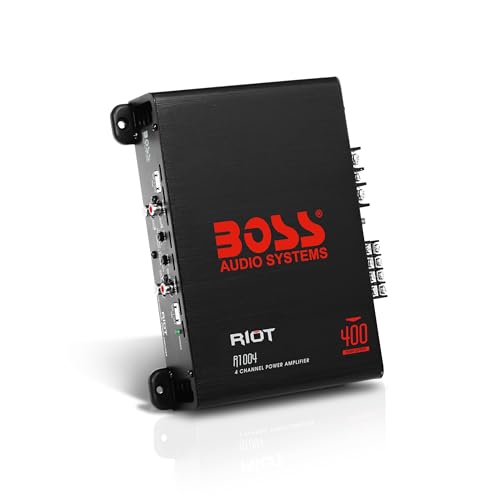
The BOSS R1004 Riot Series is a Class A/B 4-channel amplifier featuring up to 100W per channel at 2 ohms and 50W per channel at 4 ohms. It supports both high- and low-level inputs, enabling easy integration with a wide range of head units. Its robust feature set includes full-range operation and a focus on delivering strong, reliable performance across all four channels for a balanced system upgrade or a full-range speaker setup.
Orion Cobalt CBA2500.4 4-Channel Class A/B

The Orion Cobalt CBA2500.4 is a high-efficiency Class A/B 4-channel amplifier designed for car audio. It supports continuous 2/4 ohm loads and includes a MOSFET power supply, low- and high-level inputs, and adjustable low/high pass filtering with bass boost. With 2500W total output capability and a robust build, it suits larger speaker arrays and enthusiasts seeking strong, clean power with flexible crossover options for precise tuning.
Buying Guide: Key Purchase Considerations
- Power needs: Match the amplifier’s RMS power to your speaker system. Four channels at moderate power work well for front speakers; add a separate subwoofer amp if you want deep bass.
- Impedance compatibility: Check when selecting 2-ohm or 4-ohm loads. Some models bridge channels for higher power into subwoofers, others drive four mid/high speakers.
- Input options: High-level (speaker-level) inputs are useful when upgrading from factory radios without line-out adapters; RCA inputs are standard for aftermarket head units.
- Crossover control: A built-in high-pass and low-pass filter helps tailor frequency response and reduce distortion. Look for adjustable crossover points for precise tuning.
- Cooling and build quality: Consider aluminum chassis and sufficient heat sinking, especially for high-output builds in hot climates or continuous-play scenarios.
- Size and installation: Measure available under-seat or trunk space. Some models are compact (good for tight spaces) while others are larger but offer more features.
- Reliability and warranty: Choose brands with strong service support and reasonable warranty terms to protect your investment.