Upgrading to a 48V lithium battery can dramatically improve golf cart range, acceleration, and cycle life. This guide reviews several top-rated 48V LiFePO4 options that balance power, safety features, and ease of installation. Whether you’re replacing aging lead-acid cells or building a faster, more reliable cart for regular courses, these selections offer modern BMS protection, Bluetooth monitoring, and robust warranties.
A quick summary of the featured products is below. This table highlights core specs and key protections to help you compare at a glance.
| Product | Brand | Capacity | Key Features | Protection & Monitoring |
|---|---|---|---|---|
| TEMGO 48V Upgrade Kit | TEMGO | 100Ah | Charger, LCD display, App, built-in 200A BMS | Bluetooth monitoring, over/under protection, temp protection |
| DC HOUSE 48V 100Ah | DC HOUSE | 100Ah | Built-in LCD monitor, 2 monitoring options, ABS case variant | 200A BMS, Bluetooth & LCD display |
| Cloudenergy 48V 105Ah | Cloudenergy | 105Ah | 20A charger, touch monitor, 6000+ cycles | 250A BMS, mobile app, 4-in-1 kit |
| OGRPHY 48V 100Ah | OGRPHY | 100Ah | 2C/200A BMS, LCD & mobile monitor | 1000A peak, long life, 5.12kWh |
| Elefast 48V 100Ah | Elefast | 100Ah | Charger, LCD, Bluetooth, 600A peak | High-grade cells, 2C/600A, compact |
TEMGO 48V Upgrade Kit With App

TEMGO offers a comprehensive upgrade kit designed for a seamless transition from lead-acid to LiFePO4. The package includes a high-performance charger, a 2.8-inch LCD display for real-time data, and a Bluetooth-enabled 200A BMS. The system is built for longevity with 5000+ deep cycles at 80% DOD, delivering substantially longer life than traditional lead-acid solutions. The built-in BMS protects against overcharging, over-discharging, short circuits, and temperature extremes, helping maximize safety and reliability for daily golf cart use.
DC HOUSE 48V 100Ah With Smart Monitoring

DC HOUSE emphasizes ease of installation and powerful monitoring. The battery ships with either Bluetooth monitoring or a dedicated LCD screen, ensuring real-time capacity, voltage, and current visibility. The metal-clad case design provides improved safety and durability, while the internal cell mounting using metal clips enhances stability. The built-in 200A BMS supports high current demands and helps guard against thermal and electrical faults. Note that the LCD monitor and mobile app may not work simultaneously when connected to Bluetooth, a small trade-off for robust, multi-modal monitoring.
Cloudenergy 105Ah 48V LiFePO4 Battery

Cloudenergy bundles a 105Ah LiFePO4 unit with a 20A fast charger and a 2.8-inch LCD touch monitor. The kit includes a screen holder and mounting strap, simplifying installation. With 6000+ deep cycles and 80% DOD, this option prioritizes long-term cost efficiency and reliability. The included 250A BMS and mobile app support give users flexible monitoring, making it a strong choice for frequent golfers who demand consistent performance across many seasons.
OGRPHY 48V 100Ah With High-Current Flex
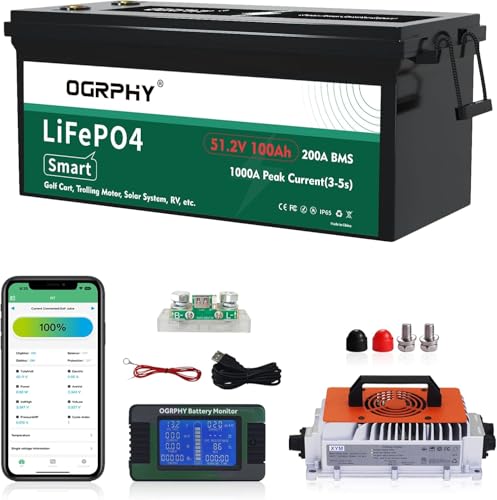
OGRPHY emphasizes high current handling with a robust 200A BMS and a 1000A peak discharge capability for short bursts. The 5.12kWh capacity supports longer drives between charges, and the 10-year lifetime with 5000+ cycles is designed to minimize replacement frequency. An LCD and mobile monitor ensure drivers can track essential metrics in real time. The unit is well-suited for carts requiring strong torque on hilly terrain or heavy loads, while maintaining safety through its protective BMS and battery management features.
Elefast 48V 100Ah With Complete Kit

Elefast provides a compact 48V LiFePO4 battery package that includes a charger, LCD touch monitor, and Bluetooth connectivity. The battery design emphasizes a lightweight footprint (about 83 pounds) with a 600A peak capability for demanding cart performance. The package highlights 2C discharge capability and robust cell quality, offering dependable acceleration and speed consistency across varied cart models from Ezgo, Club Car, Yamaha, and others. The integrated monitor system supports quick diagnostics and status checks.
Buying Guide: Key Purchase Considerations
- Battery Chemistry And Lifecycle: Look for LiFePO4 chemistry for safety, thermal stability, and long cycle life. Most models advertise 4000–6000+ deep cycles with high DoD, which lowers total cost of ownership over time compared to lead-acid.
- Capacity And Power: Capacity (Ah) and max power output (kW or A rating) determine range and acceleration. Consider your typical driving distance, terrain, and whether you need higher peak currents for motor bursts.
- Protection Systems: A strong BMS with over/under voltage protection, short-circuit protection, thermal monitoring, and automatic recovery features is essential for safety and longevity. Bluetooth and LCD monitoring add visibility for maintenance.
- Charger Compatibility: Ensure the included charger matches your golf cart’s controller voltage and that charging time fits your schedule. Fast chargers can reduce downtime but may impact long-term cycle life if not matched to battery specs.
- Installation And Fit: Consider kit completeness (mounting straps, cables, and adapters) and whether the battery fits in the existing compartment. Some units offer one-time installation with clipped cells for safety, while others provide more modular setups.
- Durability And Case Design: Metal or reinforced casings improve resistance to vibration, impacts, and weather. IP ratings or weatherproof features are beneficial for outdoor use on courses or utility vehicles.
- Monitoring And App Support: Real-time telemetry via mobile apps helps manage SOC, voltage, and temperature. LCD panels provide quick on-site checks without a phone.
- Warranty And Support: A longer warranty and accessible customer support reduce risk if a component fails. Check the terms for battery replacement and BMS coverage.
- Price Of Ownership: While Lithium setups can have a higher upfront cost, they typically deliver lower total cost over time due to longer life, lower maintenance, and better efficiency.
When choosing between options, compare the balance of capacity, peak current, and monitoring features. For frequent hill climbs or heavy loads, prioritize higher peak current (A) and a robust BMS. If long course days are common, a larger capacity and deeper cycle life offer meaningful benefits. Consider compatibility with your existing cart model and the ease of installation to minimize downtime and additional parts purchases.