Campers rely on reliable, quiet, and fuel-efficient generators to run essentials like lights, small appliances, and charging devices. The following five models blend clean power, portability, and RV readiness to help you stay comfortable on the road or at the campsite. The table below highlights key specs and what each model excels at, so you can pick the right generator for your camping style.
| Product | Brand | Power (Surge / Rated) | Fuel Type | Key Benefit |
|---|---|---|---|---|
| WEN 4800-Watt Portable Inverter Generator | WEN | 4800 / 4000 W | Gasoline | RV-ready, quiet operation |
| WEN 56360i (3600W Inverter) | WEN | 3600 / 2900 W | Gasoline | Ultra-light, extremely portable |
| WEN DF680iX Quiet Dual Fuel | WEN | 6800 / 5100 W (gas); 6000 / 4500 W (propane) | Gas/Propane | Dual fuel flexibility with CO watchdog |
| PowerSmart 4400-Watt Portable Inverter | PowerSmart | 4400 / 3600 W | Gasoline | Long runtime, quiet operation |
| Westinghouse 4650 Peak Watt Portable Generator | Westinghouse | 4650 / 3600 W | Gasoline | RV-ready outlets, extended run time |
Below are detailed product-focused sections designed to help you compare features, performance, and suitability for camping scenarios—from powering a camping fridge to charging multiple devices at once.
WEN 4800-Watt Portable Inverter Generator

The WEN 4800-Watt Portable Inverter Generator delivers 4800 surge watts and 4000 rated watts, providing clean power suitable for sensitive electronics such as smartphones, tablets, and laptops. Its compact, RV-ready design helps campers run devices without disturbing neighbors. A compact 1.9-gallon tank offers up to seven hours of runtime at half load, balancing power and efficiency for weekend trips.
WEN 3600-Watt Portable Inverter Generator

The 56360i model delivers up to 3600 surge watts and 2900 rated watts with a featherweight profile—about 46 pounds—making it easy to move between campsites. Like other WEN inverter generators, it produces clean power safe for charging modern electronics. Its portability and RV-compatibility make it a solid choice for minimalist setups or frequent travelers who value lightweight gear.
WEN DF680iX Quiet Dual Fuel

The DF680iX stands out with dual-fuel capability, running on either gasoline or propane for flexibility at the campsite. It supports 6800 surge watts and 5100 rated watts on gasoline, and 6000 surge / 4500 rated watts on propane. A bonded-neutral 240V configuration enables low-power Level 2 charging for vehicles, while the WEN Watchdog CO Shutdown Sensor adds an automatic safety shutdown to mitigate carbon monoxide risks. This model targets campers who want extended runtime with fuel choice and vehicle charging compatibility.
PowerSmart 4400-Watt Portable Inverter

The PowerSmart 4400-watt generator delivers strong starting power and a 3600-watt rated output, well-suited for home, RV, or camping needs. It features a 1.6-gallon fuel tank and promises up to 11 hours of runtime at 25% load, reducing refueling frequency during long trips. Its 76 dB operating noise level at 25% load makes it a practical option for campgrounds with noise restrictions, while EPA compliance supports responsible outdoor use.
WEN 5600-Watt Portable Generator (GN5600)

The GN5600 provides 5600 starting watts and 4500 running watts with a 4.3-gallon tank for around 12.5 hours of run time at half load. Wheel-and-handle portability makes movement between camping spots straightforward. This model suits campers who need reliable, higher power for longer periods without frequent refueling, especially when running multiple devices or a small fridge.
Westinghouse 4650 Peak Watt Portable Generator
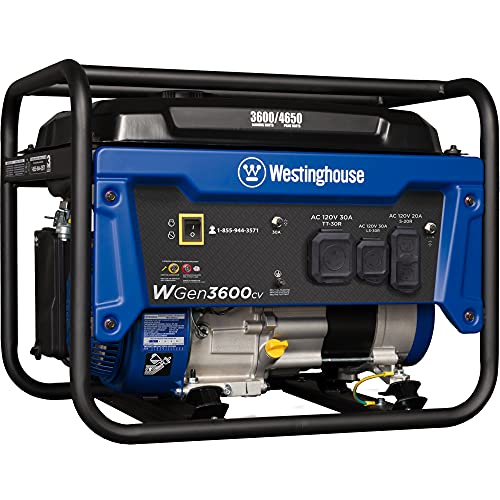
The Westinghouse 4650 Peak Watt model blends RV readiness with extended runtime. With 3600 running watts and 4650 peak watts, it supports essential appliances and lighting for camping setups. It includes a 4-gallon tank with a fuel gauge and multiple outlets, plus safety features like exhaust and CO management. Outlets are positioned for convenience at the campsite, while the design focuses on practical reliability for weekend trips or longer outings.
Buying Guide: Key Purchase Considerations And Comparisons
When choosing a generator for camping, consider the following factors to balance power, portability, and reliability:
- Power needs: Estimate the wattage of essential devices (refrigerator, lights, chargers, fans) and add a buffer. Campers typically benefit from 2000–5000 W ranges for basic setups, or higher for propulsion-assisted trailers and larger appliances.
- Portability: Check weight, wheel kits, and handles. Inverter models tend to be quieter and lighter, but gas-powered trail-ready units may offer more peak power for trailers or multi-device use.
- Run time and fuel: Look at tank size and runtime at typical load. Longer runtimes reduce refueling pauses at campgrounds; propane or dual-fuel options add flexibility in fuels available at campsites.
- Noise level: Measured in dB, quieter units (around 50–70 dB at 7–10 meters) are preferable for camp environments to respect other campers and wildlife.
- Outlets and compatibility: Ensure the generator provides standard 120V outlets, RV-specific outlets, and USB ports if you rely on mobile devices or battery packs.
- Safety features: CO sensors, automatic shutdown on low oil or high CO, and safe starting mechanisms are critical for campsites and family use.
- Fuel availability and storage: Consider how easy it is to source fuel and store it safely. Propane offers shelf-stable options that some campers prefer.
- Maintenance and warranty: Look for models with local service support and clear warranty terms to reduce downtime during trips.
- Portability vs. power trade-offs: If you frequently travel to remote sites, prioritize lighter, inverter-based options. For extended stays with higher load demands, a larger, more capable unit may be warranted.
- Parallel operation: Some models offer parallel capability to increase output when needed, but check compatibility and required kits.
In combining these considerations, campers can select a generator that balances quiet operation, fuel efficiency, and dependable power for outdoor adventures.