Adding roof rails to your car can dramatically increase cargo capacity and open up space for bikes, kayaks, cargo boxes, and more. This guide features five compatible roof rack options that fit a variety of vehicle types, from bare roofs to elevated rails. Each option emphasizes ease of installation, durability, and load performance, helping you choose the best fit for your needs.
The following table summarizes the featured products, their primary compatibility notes, and load considerations to help you compare at a glance.
| Product | Compatibility | Approx. Load Capacity | Notable Feature |
|---|---|---|---|
| Amazon Basics Cross Rail Roof Rack, 52 inches | Raised side rails, 1/2 in. gap minimum | Up to 165 lbs | Reduced wind noise seals |
| VEVOR Roof Rack Cross Bars | Bare roof or bare rail scenarios | 165 lbs | Aerodynamic aluminum design |
| Amazon Basics Cross Rail Roof Rack, 56 inches | Raised side rails, 1/2 in. gap minimum | Up to 165 lbs | Wide compatibility with rails |
| munirater Universal 43.3 inch Roof Rack | Vehicles without pre-installed racks | Not specified | Sporty look, heavy-duty construction |
| TeqHome Universal Roof Rack Cross Bars, 43-inch | Bare roof, no side rails required | 165 lbs | Anti-theft lock and easy installation |
Amazon Basics Cross Rail Roof Rack, 52 Inches
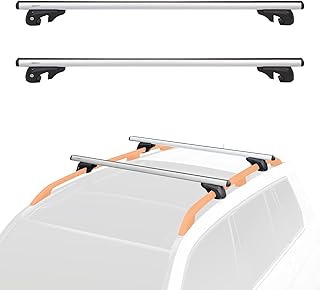
This 52-inch cross rail roof rack is designed to mount on vehicles with raised longitudinal rails. It requires a gap of at least 1/2 inch between the rail and the car roof, and the distance between the two rails should fall between 42 inches and 49.6 inches. The rails are made from a corrosion-resistant aluminum alloy and can support up to 165 lbs, making it suitable for heavy loads like luggage boxes, kayaks, or bikes. Rubber sealing strips help minimize wind noise for a quieter ride, and an installation video is provided for guidance.
Compatibility notes emphasize confirming the vehicle fit in the product description. The kit is sold as a two-pack, which can increase adaptability for wider roof setups. The overall design balances strength with a relatively low profile to reduce wind resistance during travel.
VEVOR Roof Rack Cross Bars

VEVOR’s cross bars are designed for bare roofs or vehicles without raised rails. They specify compatibility with inner rain gutter spacing around 43.3–44.5 inches and an adjustable hook range of about 49.2–56.3 inches. The system supports up to 165 lbs, making it suitable for cargo boxes, bikes, and larger items. The aerodynamic aluminum construction aims to reduce drag and wind noise, contributing to a quieter driving experience. Note the recommended maximum speed and the use of windproof covers for larger loads.
The installation is geared toward straightforward mounting without requiring permanent modifications, while still delivering a robust roof-capability. As with any bare roof rack, precise roof measurements are essential to ensure a secure fit.
Amazon Basics Cross Rail Roof Rack, 56 Inches

The 56-inch variation mirrors the 52-inch model with compatibility for raised rails and a similar spacing requirement between rails (42 to 49.6 inches) and a 1/2 inch minimum gap. It likewise uses a corrosion-resistant aluminum alloy to deliver up to 165 lbs. The 56-inch length can be advantageous for wider vehicles or longer loads, such as longer cargo boxes or boards. The kit includes the same wind-noise mitigation approach via rubber seals and points to the installation video for easy setup.
As with other Amazon Basics cross rails, verify vehicle fit according to the Product Description. The two-pack option provides flexibility for different rail spacings on compatible vehicles, and the durable build helps ensure long-term use with varying weather conditions.
munirater Universal 43.3 Inch Roof Rack Cross Bar

The munirater cross bars are tailored for vehicles lacking pre-installed racks. It targets a specific rain trough distance of 110–114 cm (43.3–44.88 inches) and a window distance of 124–134 cm (48.81–52.75 inches). The design emphasizes a sportier appearance while using heavy-duty construction to minimize vibration and improve overall fit and performance. While the features highlight fitment accuracy, potential buyers should ensure proper roof dimensions and load distribution to maximize stability on the road.
The kit is positioned as an affordable upgrade for bare roofs, with emphasis on appearance and solid materials that support practical cargo needs. Users should confirm the exact roof geometry to avoid incompatibilities with shorter or curved roof profiles.
TeqHome Universal Roof Rack Cross Bars, 43-Inch

TeqHome’s 43-inch universal cross bars are designed for bare roofs and vehicles without side rails. The installation kit includes mounting hardware and is designed for simple, drill-free mounting on flat roofs. The product highlights include an anti-theft lock system with keys and a robust ABS cover to protect the lock from weather, contributing to added security for cargo. The bars are tuned for a balance of load capacity (up to 165 lbs) and a secure fit, with attention to proper roof flatness for installation success.
This option emphasizes security and ease of installation, making it a practical choice for renters or drivers who need a temporary but reliable cross-bar setup. Always verify roof flatness and rail-groove spacing to ensure a snug, secure fit for bikes, boards, or gear.
Buying Guide
- Vehicle compatibility: Determine if your car has raised rails, a bare roof, or flush rails. Bare roofs require universal cross bars, while raised rails need cross rails that fit the rail gap and spacing.
- Load capacity: Check the manufacturer’s stated weight limit. For most standard setups, 165 lbs is common, but always confirm the actual limit and consider future loads like multiple bikes or a cargo box.
- Roof geometry: Measure rail-to-rail distance and the gap between the rail and roof where applicable. Some models require specific gaps or rail distances for a secure fit.
- Wind noise and aerodynamics: Look for rubber sealing strips or aerodynamically shaped bars to minimize noise and drag, especially for long road trips.
- Security: Consider anti-theft features such as keyed locks and robust coverings for lock mechanisms, especially if you park in public spaces.
- Installation complexity: Some options offer tool-free or minimal-drill installation, while others require more precise mounting. Review included hardware and installation videos when available.
- Durability and materials: Aluminum cross bars resist corrosion and provide strength with lighter weight. Ensure coatings are suitable for exposure to rain, salt, and sun.
- Accessory compatibility: If you plan to carry bikes, kayaks, or cargo boxes, verify that the cross bars you select are compatible with those accessories and that the total load stays within safe limits.
- Return and warranty: Consider purchasing from brands with clear return policies and warranties, especially for components that experience weather exposure.
When selecting a roof rack system, prioritize compatibility with your vehicle’s roof type, intended loads, and travel plans. A well-fitted cross bar system enhances cargo capacity, improves vehicle versatility, and maintains road safety by distributing weight evenly and minimizing wind resistance.