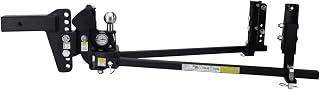
Best Adjustable Height Weight Distribution Hitch Guide
Post published:September 24, 2026
The best adjustable height weight distribution hitch choices help maintain level trailer towing across varied terrains and hitch heights. This guide targets buyers seeking stable, balanced tows with enhanced control. Ideal for towing enthusiasts, fleet operators, and DIY trailer setup seekers, these options address truck-to-trailer balance, sway reduction, and ease of use. Each product profile notes who benefits most and why it stands out for different vehicle/trailer configurations.
Product
Best For
Weigh Safe True Tow Middleweight
Best for riders who want built-in weight sensing and anti-sway on mid-range setups
ANDERSEN HITCHES Weight Distribution Kit (4″ Drop)
Best for straightforward setup and grease-free maintenance with strong tongue weight transfer
Andersen Hitches 2″ Shank, 4″ Drop
Best for heavy loads and flexible bracket sizing for precise head angle
GEN-Y Hitch Heavy Duty Tow Hitch
Best for versatile height changes with multiple positions
Fastway Connect Weight Distribution Hitch
Best for ease of setup and reliable anti-sway performance
Best for buyers who want a built-in scale feature and anti-sway performance for mid-range towing setups. The True Tow Middleweight offers a balance of weight-sensing and sway resistance, useful where trailer tongue weight varies.
Key note: This model emphasizes anti-sway technology and safety integration, making it a strong fit for mixed loads and medium-height hitch configurations.
ANDERSEN HITCHES Weight Distribution Kit 4″ Drop
Best for users seeking a grease-free system with easy tension chain setup for straightforward hitching and level towing.
This Andersen option uses a friction cone and tension chains, reducing maintenance and simplifying assembly compared with traditional spring bars. It is rated for up to 10,000 lbs GTWR with a 4-inch drop and a 2″ ball—suiting mid-to-large bumper-pull trailers.
Caution: Some users may require compatible mounting hardware or-bracket adjustments to fit specific trucks; verify fit before purchase.
Best for heavier bumper-pull loads and precise head angle with flexible brackets. The 14,000 lbs GTWR rating makes this a strong choice for larger trailers.
Why chosen: The flexible bracket sizing helps dial in the ideal towing geometry, plus the tension chain system reduces setup effort.
Limitation: Heavier weight and wider footprint may require more space and careful alignment during hitching.
Best for trailers requiring multiple height positions with a versatile 7.5″ total range. Its dual-ball design and multiple positions suit varied road heights and vehicle combinations.
Selected for flexibility and a wide range of adjustment positions, enabling precise tongue weight balance.
Caution: The assembly may require careful alignment for optimal performance across several positions.
Best for buyers who want a fast, straightforward setup with reliable sway control in a compact package.
Choosing this option supports steady handling, especially for vehicles with varied hitch heights, while keeping installation approachable for hobbyists.
Buying Guide
What should I consider when choosing an adjustable height weight distribution hitch?
Key factors include towing capacity (GTWR and tongue weight), drop/rise range, shank size, and bracket options. Confirm compatibility with your trailer’s coupler size and the receiver on your tow vehicle. Consider whether you prefer grease-free operation, tension chains, or integrated weight sensing for precise balance.
How does height adjustability impact towing stability?
Height adjustments help maintain a level hitch, which keeps suspension geometry closer to factory alignment. A level setup improves steering response, reduces trailer sway, and distributes tongue weight more evenly across the vehicle-trailer combination.
What are common trade-offs with heavy-duty hitches?
Higher capacity often means heavier, bulkier components and more complex installation. More positions and longer drop ranges may add weight and cost. Assess whether the added versatility justifies the extra investment for your typical loads.
Which features influence maintenance and longevity?
Grease-free systems reduce maintenance and mess. Tension chains offer quicker hitching and unhitching, while anti-sway technology provides ongoing stability. Consider how often you hitch and unhitch and your willingness to service moving parts.
How should I size a weight distribution hitch for my trailer?
Match the GTWR to your trailer’s weight, and ensure tongue weight falls within the hitch’s recommended range. A 10,000–14,000 lb GTWR range covers most standard bumper-pull trailers; higher capacities suit larger rigs. Verify the shank and bracket options align with your vehicle’s receiver and mounting space.
What about installation and fitment?
Many options use a tension-chain setup for faster attachment. Some models offer adjustable brackets to dial in head angle. Measure your vehicle’s receiver height and trailer height before purchasing to avoid a mismatched setup.
Summary of top picks
The selection above emphasizes varied needs: weight-sensing and anti-sway for mid-range towing (Weigh Safe Middleweight); grease-free and quick setup for ease of use (Andersen entries); high-tow-ability with flexible brackets (GEN-Y and Andersen 4-inch drop); and overall simplicity with reliable sway control (Fastway Connect).
FAQ
Q: Do these hitches work with 2-inch and 2.5-inch receivers?
A: Most models listed support standard bumper-pull configurations; confirm receiver size for each product page.
Q: Is grease-free maintenance worth it?
A: Yes for reduced mess and easier upkeep; typically paired with simple tension chain systems.
Q: Will a higher drop hurt performance?
A: Not if matched to trailer height and vehicle clearance; improper drop can cause clearance issues or poor tongue weight balance.
Q: Should I prioritize anti-sway over height adjustability?
A: Refer to your trailer’s specifications and the hitch’s tongue weight range; aim to keep tongue weight within the recommended percentage of trailer weight.