When selecting a circle track racing carburetor, the goal is reliable fuel delivery, precise airflow, and compatibility with high-horsepower engines. This guide highlights five top options, detailing who they’re best for and why they stand out. Whether you race sprint cars or late-models, these carburetors are chosen for proven performance and build quality. Buyers will find options suitable for gas-powered circle track engines, including mechanical and vacuum secondary designs, with attention to airflow, calibration, and ease of tuning. The table below summarizes the highlighted models.
| Product | Appropriate For | Key Benefit |
|---|---|---|
| Holley 0-4412CT 2300 Series | Open-wheel and dirt circle tracks | High 500 CFM with gasoline calibration |
| ProForm 650 CFM Circle Track | Mid-range circle track engines | Compact design with mechanical secondary option |
| ProForm 67215 Race Series 750 CFM | High-horsepower circle track builds | Dual inlet, 4-barrel, molded wedges |
| Holley 080802HBX | Drag or circle track high-horsepower setups | Balanced airflow through contoured venturi |
| Holley 080804BKX | High-performance circle track or drag | Outward air bleeds for smoother top-air transition |
Holley 0-4412CT 2300 Series Race Carburetor

Best for race engines requiring a compact, high-flow carburetor in circle-track setups, the Holley 0-4412CT is calibrated for gasoline with a 500 CFM rating. Its 2300 Series design suits engines tuned for sprint and dirt track racing where quick throttle response matters. This model emphasizes reliability in a racing environment with screw-in air bleeds to adjust air velocity and fuel delivery.
Who it’s best for: racers needing a proven, compact 500 CFM carb for circle-track engines with straightforward tuning. Why selected: robust construction and race-oriented calibration support consistent performance under competitive conditions.
Caution: The 500 CFM rating makes it most suitable for engines around that airflow; significantly larger engines may require higher capacity models, and calibration must match fuel and ignition tweaks.
ProForm Carburetor 650CFM Circle Track Gas Mech. Sec.

This 650 CFM circle-track carburetor balances airflow and metered fuel for mid-range horsepower builds. The mechanical secondary design supports dependable opening under race conditions, maintaining throttle response when the pressure changes on dirt and asphalt ovals. The compact form aids installation in tight engine bays common on circle-track cars.
Who it’s best for: teams seeking a reliable, mid-range carb with a simple mechanical secondary setup. Why selected: good balance between airflow, tuning ease, and track reliability for varied track conditions.
Caution: If your engine requires very aggressive fueling curves or higher CFM, this unit may be outpaced by larger 750 CFM options.
Proform 67215 Race Series 750 CFM Circle Track

Designed for high-horsepower circle-track engines, this 750 CFM dual-inlet, four-barrel square bore carburetor features mechanical secondary operation and molded wedge floats for consistent fuel metering. The dual inlet design can support higher airflow demands and stable fuel supply during aggressive racing conditions.
Who it’s best for: race teams needing maximum airflow and robust metering for powerful engines. Why selected: the dual inlet and higher CFM make it a strong option for demanding tracks and engine classes.
Caution: Higher airflow can require more precise tuning to prevent fuel bog or rich mixtures at certain RPM ranges.
Holley 080802HBX Carburetor
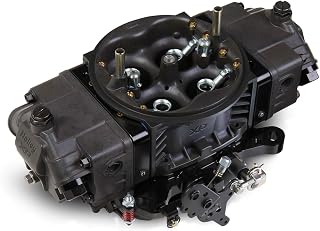
Best for drag and circle-track high-horsepower builds, the Holley 080802HBX is designed to deliver balanced airflow for enhanced horsepower. Its venturi and calibration focus on smooth top-to-bottom airflow transitions, supporting strong throttle response and consistent power delivery through the straightaways and corners of oval tracks.
Who it’s best for: racers running high-horsepower engines that require steady air-fuel balance and strong top-end power. Why selected: contoured air intake helps maximize performance while preserving driveability on track.
Caution: Precise tuning is crucial; aggressive engines may require careful air bleed adjustments to avoid a rich or lean transition under load.
Holley 080804BKX Carburetor

Engineered for drag and circle-track use, this Holley carburetor features a contoured venturi inlet for balanced airflow and outward air bleeds to facilitate a smoother transition of air into the venturis. It is suited for high-horsepower apps where precise metering and quick throttle response are essential.
Who it’s best for: high-performance builds that require balanced airflow and refined venturi design. Why selected: airflow balance and venturi tuning can yield smoother transitions at high rpm.
Caution: Outward air bleeds can require careful calibration to ensure optimal air-fuel mixtures across all RPM ranges.
Buying Guide: Circle Track Carburetor Considerations
- Airflow needs: Match CFM to engine displacement and track demands. Higher CFM supports more horsepower but may require tuning adjustments.
- Secondary system: Mechanical vs. vacuum secondaries affect throttle response and reliability in different race conditions.
- Inlet and venturi design: Contoured venturis and straight air paths improve efficiency and power delivery.
- Calibration: Screw-in air bleeds and metering blocks enable precise tuning for track surface and fuel type.
- Installation space: Consider carburetor size and linkage compatibility with your intake manifold and throttle linkage.
FAQ
- What is CFM and why does it matter for circle-track carburetors?
– CFM measures how much air the carburetor can move; higher CFM suits bigger engines and higher horsepower applications, but requires careful tuning to avoid running rich or lean. - Should I choose mechanical or vacuum secondaries for circle track racing?
– Mechanical secondaries offer quicker opening and can be more predictable under race conditions; vacuum secondaries can provide smoother transitions in some setups. - Do dual inlet carburetors improve performance on circle tracks?
– Dual inlets can supply more air at high RPM, supporting higher horsepower engines, but require precise fuel metering to prevent imbalances. - How important is venturi design for on-track performance?
– Venturi design affects airflow balance and throttle response; smoother transitions help maintain power across RPM ranges. - Can I mix carburetors from different brands?
– Mixing brands is not recommended without verifying compatibility with intake manifolds, linkage, and fuel systems to avoid tuning instability.