Looking for a reliable digital automotive battery analyzer to quickly assess battery health, cranking, and charging systems? This guide pinpoints five top options, highlights who they’re best for, and explains why each is a strong pick. Whether you’re a DIY mechanic, professional technician, or a weekend warrior, these tools help you identify weak batteries, alternator problems, and starting issues before they cause stalling or roadside trouble. Below is a quick summary table of the featured products to compare at a glance.
| Product | Best For | Why It Stands Out |
|---|---|---|
| General car, truck, and motorcycle owners | Solid 12V testing with wide CCA range; compact and user-friendly | |
| Users needing speed and accuracy | Faster results, strong SOH/SOC metrics, color display | |
| Budget-conscious shoppers | Good 24V/12V tests, solid performance | |
| Looking for a straightforward diagnostic | Digital display, clear testing of charging and cranking | |
| MOTOPOWER MP0515A | Simple, reliable everyday checks | Compact and easy-to-use baseline tester |
TOPDON BT100 12V Car Battery Tester
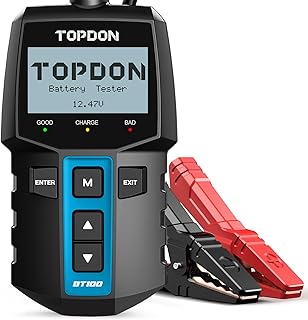
Best for general car, truck, motorcycle, and boat owners who want a versatile 12V tester with wide CCA coverage. The BT100 provides essential battery health checks and alternator testing to flag potential failures before they cause a breakdown. Ideal for home garages and small shops seeking a comprehensive single-tool solution.
Caution: Check battery terminals for corrosion before testing to avoid skewed readings.
FOXWELL BT705Plus Car Battery Tester

The BT705Plus is a next-generation upgrade designed for speed and accuracy. It performs complete battery, cranking, and charging tests, delivering results up to 30% faster with a powerful processor and refined algorithms. It’s best for users who need quick, reliable diagnostics on starting and charging systems across cars, trucks, and heavy-duty applications.
Best for: Quick, precise diagnostics with clear color readouts. This is the pick for technicians who test frequently and value fast feedback.
Limitation: The device’s features depend on battery voltage conditions; very low-voltage states may require longer test times.
FOXWELL BT705 Car Battery Tester

The BT705 is a capable unit for 24V and 12V systems, offering robust accuracy for cranking and charging tests. It’s best for users who want a reliable, mid-range option with a clear user interface and longer cables for solo testing. The device excels at identifying cold-start risks and alternator problems before they cause outages.
Best for: Users who value a clear, no-fuss display and dependable performance in daily vehicle diagnostics.
Limitation: The more advanced data sets may require familiarity with automotive electrical terminology.
ANCEL BA101 Car Battery Tester
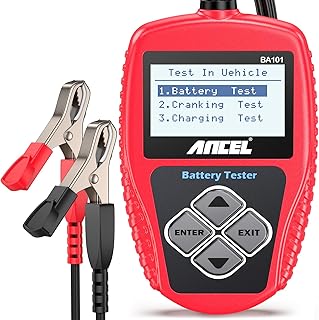
The BA101 offers a straightforward 12V diagnostic experience with digital readouts for charging and cranking analysis. It’s best for technicians or hobbyists who want a reliable, easy-to-read tool without extra bells and whistles. This unit can help confirm whether a battery is truly healthy or if the charging system needs attention.
Best for: Clear, simple diagnostics with a focus on consistent, readable results.
Limitation: Fewer advanced metrics compared to higher-end models may limit in-depth analysis.
MOTOPOWER MP0515A 12V Car Battery Tester

The MP0515A is a compact, user-friendly tester covering essential 12V battery checks and basic cranking/charging assessments. It’s best for everyday drivers who want a dependable, affordable option for routine battery health checks and quick readiness assessments before trips.
Best for: Everyday readiness checks with a simple interface and compact design.
Limitation: It provides essential data but fewer advanced metrics than premium models.
Buying Guide
What should you look for in a digital automotive battery analyzer?
Key factors include voltage range, CCA coverage, and the ability to test cranking and charging systems. A larger, color display helps readability in bright conditions, while longer test leads enable solo testing from the driver’s seat. Consider whether you need 12V only or 24V compatibility as well, and whether you prefer faster results or deeper diagnostic data.
How does the test data translate to real-world decisions?
Look for outputs like state of health (SOH) and state of charge (SOC), cranking voltage, and charging ripple. These metrics indicate battery condition and potential alternator issues. Clear indicators and intuitive readouts help you decide if a replacement is needed or if charging system repair is warranted.
Who benefits most from these tools?
DIY enthusiasts gain value from all-around testers that combine battery, cranking, and charging tests. Professional technicians may prioritize faster processing, higher accuracy, and more advanced data. Vehicle type matters; some units favor small engines, others support heavy-duty applications like trucks or boats.
Are there any caveats to consider?
Tests rely on battery condition and ambient temperature. Extremely low or high temperatures can affect readings. Also, always inspect battery terminals for corrosion, ensure proper connections, and follow safety guidelines when handling automotive electrical systems.
How to choose among these five?
- Best overall balance: FOXWELL BT705Plus for speed and accuracy.
- Best value option: FOXWELL BT705 for solid performance at a lower price point.
- Best for 12V and versatility: TOPDON BT100 with broad CCA coverage.
- Best for simple, straightforward testing: ANCEL BA101.
- Most compact, everyday tester: MOTOPOWER MP0515A.
FAQ
- What is a digital automotive battery analyzer used for? It tests battery health, plus starting and charging system performance to prevent unexpected failures.
- Do these tools require professional installation? No, they are designed for consumer use with straightforward connections to the battery terminals.
- Can I test 24V systems with these devices? Some models, like the BT705Plus and BT705, support 24V testing; check each product’s specifications.
- Will readings change with cold weather? Yes, temperature affects readings; use readings as comparative indicators rather than absolute values in extreme conditions.
- How often should I test my battery? Test when you notice slow cranking, flickering lights, or after long storage periods to gauge remaining capacity.
- Are these testers compatible with all battery brands? Most testers support common lead-acid, AGM, and similar chemistries, but always verify compatibility with your battery type.