Answering the common buyer question, these floor jacks provide controlled lifting for cars with varying weight capacities and lift ranges. They’re ideal for home garages, shop setups, and quick maintenance tasks. Choose based on vehicle weight, lifting height, and portability to fit your workspace and tasks.
| Product | Best For | Key Benefit |
|---|---|---|
| TONDA Floor Jack, 3,800 lb | Mid-size cars, sedans | Built-in safety valve for overload protection |
| TONDA Floor Jack, 1.5 Ton | Compact cars, lightweight projects | Portable design with carrying handle |
| AV Steel 2.5 Ton Low Profile | Low clearance sedans and coupes | Low profile lift while handling 5,000 lb |
| 3-Ton Dual Pistons Heavy-Duty | Racing/off-road and larger cars | Dual pistons with quick lift |
| Maxority 3-Ton Low Profile | General maintenance on mid-size vehicles | Dual pistons, quick lift pump |
TONDA Floor Jack, 3,800 lb Hydraulic Car Jack

Capacity and safety: 3,800 lb hydraulic jack with a built-in safety valve. The safety feature helps protect against overloading and supports controlled operation within the jack’s rated capacity, making it suitable for mid-size cars and sedans. Lifting range provides flexibility for common garage tasks.
Best for: Home garages handling typical sedans and compact SUVs that fall within the 3,800 lb range. The built-in safety valve supports steady operation when working alone.
Caution: Ensure correct placement under the chassis and verify the jack’s rated capacity for the specific vehicle weight to avoid overloading.
TONDA Floor Jack, 1.5 Ton Hydraulic Car Jack
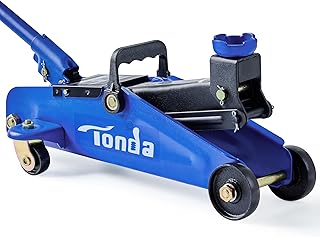
Capacity and portability: 1.5-ton (3,000 lb) capacity with a compact, portable design. The built-in handle makes it easy to move and store in small spaces, ideal for light maintenance tasks on compact cars or daily-use vehicles.
Best for: Shoppers with limited garage space or those who need a lightweight jack for quick lifts on smaller cars.
Caution: Not suitable for heavier vehicles or frequent heavy-duty lifting; verify vehicle weight before use.
AV Steel Low Profile Floor Jack 2.5 Ton
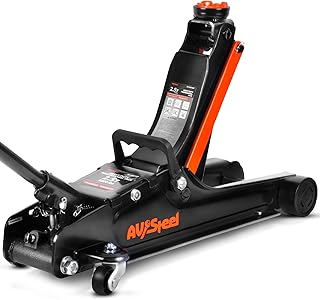
Low-profile design and range: This 2.5-ton jack lifts from 3.4″ to 14.6″, making it suitable for cars and sedans with lower clearance. It uses a single piston pump mechanism for lifting and is labeled not for trucks or SUVs.
Best for: Drivers with low-clearance vehicles or sports cars that require a compact, low-profile jack for undercar access.
Caution: Not designed for larger trucks or SUVs; use within stated capacity and lift range.
3-Ton Low-Profile Dual Pistons Heavy-Duty Floor Jack

Dual pistons and quick lift: A heavy-duty 3-ton jack with dual pistons and a quick lift hydraulic pump, designed for faster lifts and easier setup. It includes a foot pedal and extension adapter for varied tasks.
Best for: Users performing frequent maintenance on mid-to-full-size cars, especially where faster lifting is desirable.
Caution: Heavier and larger than basic models; requires stable space and proper floor support for safe operation.
Maxority 3-Ton Low Profile Hydraulic Floor Jack

Capacity and design: 3-ton low-profile hydraulic jack with dual pistons and a quick lift pump. It is described for home and workshop car maintenance across a range of vehicles.
Best for: Those seeking a versatile, mid-size jack suitable for various vehicles, balancing capacity with a low profile for easier undercar access.
Caution: Color is random; consider storage and color preference as a minor factor in longer-term use.
Buying Guide
What capacity do you need?
Match vehicle weight to jack capacity. For most sedans and compact SUVs, 3,000–3,800 lb jacks suffice. Heavier trucks or SUVs require higher capacities such as 5,000–6,000 lb models.
What lift height is required?
Consider the minimum and maximum lift heights. Low-profile jacks are easier for cars with low clearance, while taller ranges help with SUVs or lifted vehicles.
What design features matter?
Safety valves protect against overloads. Dual pistons can provide quicker lifts. Portability and a carrying handle help with storage. Extension adapters can widen compatibility for different tasks.
What space and usage context?
For small garages, a compact or low-profile jack is advantageous. For frequent maintenance or racing setups, a heavier-duty model with quicker lift and robust construction may be better.
Maintenance and safety tips
- Inspect the jack for leaks and wear before each use.
- Use a flat, solid surface and engage wheel chocks when lifting a vehicle.
- Never exceed the listed capacity and stop if the jack shows signs of instability.
- Lower to the surface slowly and never work under a vehicle supported by a single jack.
Quick comparison by task
- Best for space-constrained garages: 1.5 Ton and AV Steel low-profile models.
- Better for mid-size sedans: 3,000–3,800 lb Jacks from TONDA and Maxority lines.
- Choose this if you frequently lift quickly: Dual-piston models with quick lift pumps.
- Avoid this if you need to lift trucks or SUVs beyond 5,000 lb: select higher-capacity jacks.
Short FAQ
- What is a good first floor jack to own? A mid-range capacity low-profile floor jack is a versatile starting point for many cars.
- How do I know the right lift height for my car? Check your vehicle’s ground clearance and the jack’s listed lift range.
- Are dual pistons worth it? They can provide faster lifts and smoother operation in many maintenance tasks.
- Can I use a floor jack on asphalt or gravel? Use a solid, level surface and consider a jack pad or board for stability.
- Should I buy multiple jacks or one versatile model? One versatile, adequately rated jack is often sufficient for most home garages.
- Is a safety valve essential? Yes, safety valves help protect against overloading and ensure controlled lifting.