If you’re shopping for a generator that runs on gas or propane, you want reliable power, quiet operation, and clear indications of what each model is best for. This guide showcases five dual‑fuel generators that balance convenience with performance for home backup, camping, and remote use. Each pick is explained with who it’s best for, why it stands out, and a practical limitation to consider. The top choices include compact inverter models for neighborhoods and RV sites, plus larger portable units capable of whole‑home support.
| Product | Fuel Types | Best For |
|---|---|---|
| PowerSmart 3800 Watt Dual Fuel Inverter Generator | Gas, Propane | Quiet residential use, camping, RVs |
| Westinghouse 4650 Peak Watt Dual Fuel Portable Generator | Gas, Propane | RV trips, short outages, tailgating |
| Westinghouse 6500 Watt Dual Fuel Home Backup Portable Generator | Gas, Propane | Home backup with transfer switch ready |
| Westinghouse 12500 Watt Dual Fuel Home Backup Portable Generator | Gas, Propane | Whole‑home power, advanced outlets |
| WEN DF5600X 5,600‑Watt Dual Fuel Portable Generator | Gas, Propane | Emergency backup with CO watchdog |
PowerSmart 3800 Watt Dual Fuel Inverter Generator
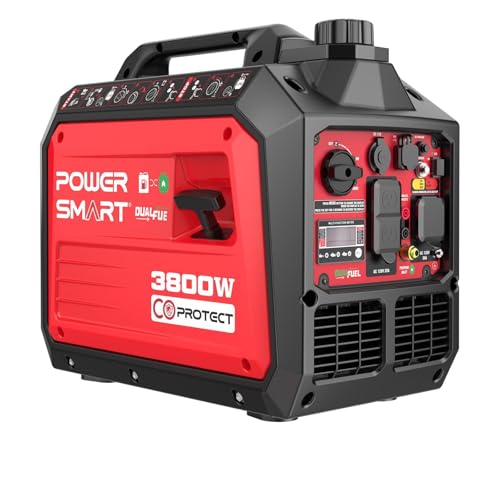
Best for quiet, mobile power in neighborhoods or campgrounds. This model delivers 3800 starting watts and 3300 running watts on gasoline, with up to 10 hours of runtime, and 3500 starting watts/3100 running watts on propane for longer fuel availability. Its inverter technology provides a clean sine wave with less than 3% total harmonic distortion, protecting sensitive electronics. The built‑in CO sensor adds a safety layer for indoor or tent use. Pros include quiet operation (65 dBA at 23 feet) and RV‑ready outlets. Limitation: dual‑fuel performance is ideal for moderate loads; higher power needs may require a larger unit.
Westinghouse 4650 Peak Watt Dual Fuel Portable Generator
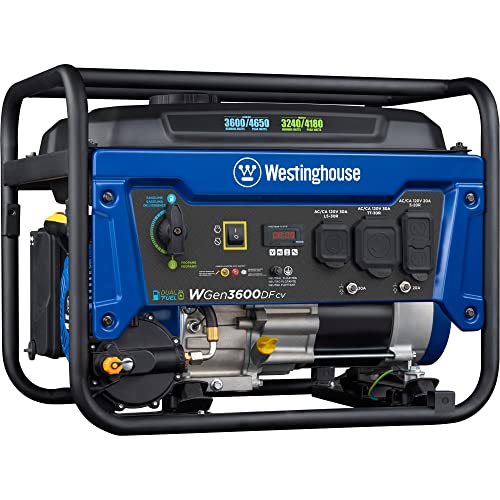
Best for RV trips and tailgating with multiple outlets. It offers 4650 peak/3600 running watts on gas and 4650 peak/3240 running watts on propane, plus a 4‑gal fuel tank and run times up to 14 hours per tank. It includes a 5‑20R duplex, a TT‑30R RV outlet, and an L5‑30R for additional versatility. A key advantage is its compact build and pluggable kit. Caution: heavier than ultra‑compact models, so transportation may require a cart or wheels not included by default.
Westinghouse 6500 Watt Dual Fuel Home Backup Portable Generator
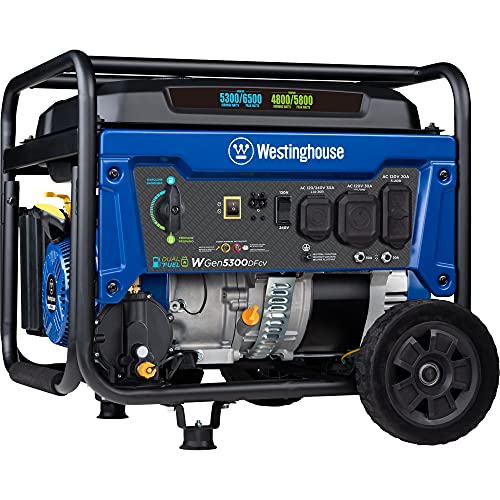
Best for whole‑home backup readiness with transfer switch compatibility. Gasoline mode provides 5300 running watts/6500 peak, propane mode offers 4800 running/5800 peak watts. A 4.7‑gallon fuel tank with gauge supports up to roughly 14–15 hours at moderate loads. It features multiple outlets including standard 120V duplex, RV‑ready TT‑30R, and L14‑30R transfer switch receptacle, all with safety covers. Advantage: robust power for mid‑to‑large loads. Limitation: larger footprint and heavier weight than inverter models, requiring setup space.
Westinghouse 12500 Watt Dual Fuel Home Backup Portable Generator

Best for whole‑home power with transfer switch readiness and multiple heavy‑duty outlets. Gasoline mode provides 9500 running/12500 peak watts; propane mode provides 8500 running/11200 peak watts. Features include a 6.6‑gallon tank, remote start, and multiple essential outlets (GFCI 120V, TT‑30R RV, and L14‑30R). Its VFT display shows real‑time voltage, frequency, and hours. Choose this for substantial outage coverage where higher wattage is required. Limitation: high power comes with higher fuel consumption and larger size; consider delivery and storage space.
WEN DF475T 4,750‑Watt Dual Fuel Portable Generator

Best for flexible, mid‑range back‑up with 4750 surge/3800 running watts on gas and 4350 surge/3500 running watts on propane. Features a 224cc OHV engine with electric start and a wheel kit for portability. It’s suitable for powering essential circuits during outages or camping setups. Limitation: not designed for prolonged full‑home power; best for essential circuits and lighter loads.
WEN DF5600X 5,600‑Watt Dual Fuel Portable Generator

Best for robust emergency backup with CO watchdog safety. It runs on gasoline at 5600 surge/4500 running watts and on propane at 5000 surge/4050 running watts. Electric start simplifies operation, and the unit is designed with a CO shutdown feature for safety. Suitable for larger outages or powering multiple circuits. Limitation: while portable for its class, it’s heavier and may require careful handling and storage planning.
DuroMax XP13000EH 13,000‑Watt Dual Fuel Generator

Best for comprehensive whole‑home backup with heavy loads. This unit offers 13,000 watts (gasoline) or dual‑fuel performance with propane compatibility. It emphasizes durable construction and a broad power range, suitable for storms or extended outages. Limitation: higher upfront cost and larger footprint; best for users needing maximum wattage and transfer‑switch readiness.
Buying Guide: Key Purchase Considerations
- Fuel type and availability: Dual‑fuel units offer flexibility to switch between gasoline and propane depending on fuel supply and price.
- Power needs: Match starting and running watts to your essential loads. Inverter models are ideal for electronics, while larger open‑frame generators cover whole‑house needs.
- Noise and portability: Inverter generators tend to be quieter and lighter; conventional engines offer higher wattage but are louder and heavier.
- Run time and fuel capacity: Consider tank size and efficiency, especially for outages or remote work sites.
- Safety features: Look for CO sensors, auto shutoff on low oil, and safe outlet enclosures.
- Outlets and compatibility: Ensure you have the necessary outlets (TT‑30, L14‑30, 5–20R) and consider transfer switch readiness.
- Maintenance and support: Check for included accessories (oil, funnel, hoses, wheel kits) and ease of service availability.
Frequently Asked Questions
- What is the difference between peak watts and running watts?
Answer: Running watts indicate continuous power output, while peak watts reflect short‑term surge capacity for starting loads. - Is dual‑fuel better than single‑fuel?
Answer: Dual‑fuel provides flexibility when one fuel is scarce or expensive, which can be valuable during outages. - Can I run a generator indoors?
Answer: No. Always operate outdoors with proper ventilation and CO safety sensors; never use in enclosed spaces. - Do inverter generators handle heavy loads?
Answer: Inverter models are best for sensitive electronics and moderate loads; for full home backup, larger units may be needed. - What maintenance is required for dual‑fuel units?
Answer: Regular oil changes, air filter checks, spark plug inspections, and fuel system maintenance per manufacturer guidance. - Do I need a transfer switch for home backup?
Answer: A transfer switch is strongly recommended for safe, code‑compliant whole‑home power distribution during outages.