Answering the most common buyer questions, this guide helps you choose reliable marine fuel sending units and gauges for various tank depths and fuel types. These components measure fuel, water, and general level information to keep you informed while on the water. The selections below are best for boaters needing adaptable depth ranges, corrosion resistance, and straightforward installation. They suit small to mid-size vessels, RVs, and trucks with marine-grade tanks.
Summary table of selected products at a glance:
| Product | |||
|---|---|---|---|
| Marine Fuel Sending Unit, 6-12″ Depth | 6–12 inches | 33-240 ohm gauge | Small tanks or tighter spaces; easy cut-to-fit for adjustable depth |
| Marine Fuel Sending Unit, 4-28″ Depth | 4–28 inches | 33-240 ohm gauge | Wide-range tanks; flexible for longer depths |
| RUPSE Stainless Steel Fuel Sender | 6.8 inches (175 mm) noted | 8 backlight colors; 1/Empty–Full scale | Durable, corrosion-resistant fuel/water sensing |
| KAOLALI 0–190/240–33 Ohm Sender | Multiple length options up to 450 mm+ | 0–190 ohm or 230–33 ohm | Multiple tank depths; high-quality stainless steel |
| Rupse 6″ Stainless Sender | 6 inches | 8 backlight colors; 1/Empty–Full | Compact boats; easy wiring and installation |
Marine Fuel Sending Unit, 6-12″ Depth

The unit is designed as a replacement for broken boat fuel sending units in marine tanks with depths from 6 to 12 inches. It fits RVs, cars, and trucks with 33-240 ohm gauge compatibility. The key benefit is a cuttable float rod, enabling on-demand depth adjustment. This makes it suitable for boats with compact or irregular tank shapes. It provides a straightforward readout of fuel and water levels, helping drivers avoid running dry in shallow yet widespread tank layouts. A potential limitation is that maximum depth compatibility ends at 12 inches, so very deep tanks may require a longer version.
Best for: small craft and tight spaces where you need a simple, cut-to-fit solution. Choose this if your tank depth sits within 6–12 inches and you want an easy retrofit without complex installation.
Marine Fuel Sending Unit, 4-28″ Depth

This model covers a broad depth range from 4 to 28 inches, making it versatile for larger tanks or varied installations. It uses a 33-240 ohm gauge and includes the same easy-to-cut float rod concept for depth customization. The flexible approach helps avoid reworking entire fuel systems when tank depth changes or when adapting to different boats. The note of potential caveat is that deeper tanks near the 28-inch maximum may demand precise alignment to ensure accurate fuel readings in extreme configurations.
Best for: vessels with larger or irregular tanks where depth can vary between 4 and 28 inches. Choose this if you want a single sender that fits multiple boat setups and you’re prepared to fine-tune during installation.
RUPSE Stainless Steel Fuel Sender

RUPSE offers a robust stainless steel exterior with internal reed switches for reliable measurement. It’s designed for multiple fluids including gasoline, diesel, and water, with IP67 waterproofing and an anti-fog curved glass gauge. The 8 backlight color options aid readability in varying light conditions. It uses a standard SAE 5-hole mounting pattern and includes a gasket and screws for installation. Best for: boaters seeking long life, corrosion resistance, and clear visibility in dim or bright environments. Limitation: installation is more involved due to multiple wiring steps and the need to align the backlight correctly with the gauge.
KAOLALI 0–190/240–33 Ohm Sender
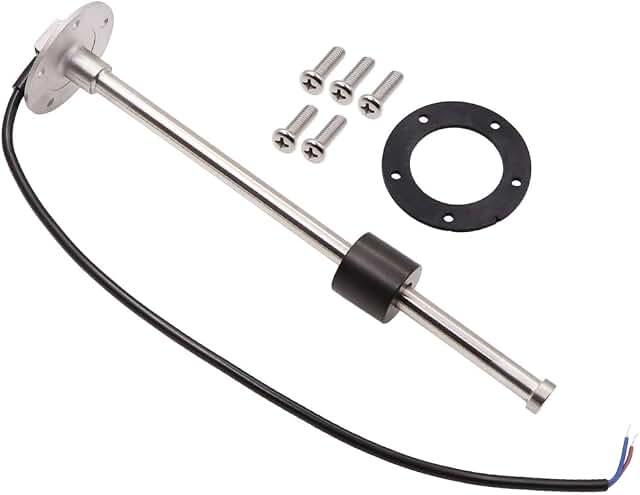
KAOLALI provides a stainless steel fuel sending unit with multiple length options and dual resistance ranges (0-190 ohm or 230-33 ohm). This versatility supports various gauges and tank depths, with options up to 500 mm in length. The unit adheres to a standard SAE 5-hole mounting pattern and uses a durable gasket for sealing. Best for: DIY installers needing a broad selection of lengths and resistance configurations; it’s well-suited to deeper tanks. Caution: ensure correct signal range for your specific gauge to avoid misreadings.
Rupse 6-Inch Stainless Sender

This Rupse unit is a compact 6-inch stainless steel sender with an 8-color backlit gauge for easy reading. It’s designed for quick installation using the SAE 5-hole pattern and includes wiring terminals for straightforward wiring. Best for: small to mid-sized boats with tight engine rooms where a compact sender is preferable. Limitation: shorter length means it may not suit deeper tanks without modification or alternative versions.
Buying Guide: Core Considerations For Marine Fuel Sending Units
Tank depth compatibility matters most. Match the depth range to your tank to ensure accurate readings. Flexible, cut-to-fit designs help accommodate nonstandard tanks.
Gauge compatibility is critical. Many units advertise 33-240 ohm compatibility; verify your gauge’s resistance range to avoid mismatched readings.
Corrosion resistance and materials affect longevity. Stainless steel housings, sealed units, and IP-rated waterproofing provide longer life in harsh marine environments.
Installation ease versus durability. Standard SAE 5-hole patterns simplify mounting, but consider gasket quality and wiring complexity when planning.
Readability matters in different light. Backlit gauges improve visibility at night or in bright reflections off the water.
Maintenance and serviceability. Look for units with replaceable seals, accessible wiring, and clear installation diagrams to ease future servicing.
Common Questions And Quick Answers
- What tank depth do I need? Measure your fuel tank depth and choose a unit that either matches or is easily cut to fit, within the unit’s stated range.
- What gauge resistance should I expect? Check your gauge’s resistance requirements (e.g., 33-240 ohms) and select a sender that matches.
- Is stainless steel always best? Stainless steel offers corrosion resistance and durability, especially in saltwater environments, but ensure the sensor’s inner components are compatible with your fuel type.
- Will a backlit gauge help me at night? Yes, backlight improves readability in dawn, dusk, and sun glare conditions on the water.
- Can I install this myself? Many units use standard SAE mounting patterns and come with gaskets and screws, making DIY installation feasible for capable DIYers.
- Do all senders measure water and fuel? Several models read fuel and water levels or fuel only; verify features if you need dual readings.
When selecting a unit, consider tank depth, gauge compatibility, build quality, and installation effort. The five products above cover common depths, multiple materials, and various installation complexities to help you choose the best match for your boat and fuel system.