If you tow with an RV, a reliable safety cable kit is essential to prevent accidental decoupling and protect your load. This guide highlights five top options and explains who each is best for, so you can choose confidently. Whether you drive a Class III RV, a boat trailer, or a heavy equipment tow, these cables offer strong connections, corrosion resistance, and practical designs for easy storage and use. The following table summarizes the main picks for quick comparison.
| Product | Capacity | Best For |
|---|---|---|
| PSLER Safety Cable Kit | 7 ft, 7,500 lbs | Heavy-duty Class III RVs and long-distance towing |
| BX88196 Safety Cable Kit | 7 ft, 7,500 lbs | Rugged, weather-exposed setups |
| WLL 451268 Trailer Safety Cables | 68 inches, 12,000 lbs (pair) | Higher-capacity dual-cable needs |
| Trailer Safety Cables with S Hooks | 44″ & 79″, 5,000 lbs | Compact, camper and utility trailers |
| Curt 80151 Safety Cable Assembly | Standard S-hook assembly | General purpose towing and compatibility |
PSLER Safety Cable Kit with S-Hooks

The PSLER kit includes a 7 ft length with 7500 lbs capacity and vinyl-coated, rust-proof S-hooks with safety latches. It is designed for Class III tow systems and fits heavy-duty RVs, boats, and towed vehicles. The coiled design keeps cables off the ground and reduces snagging, while offering ample reach for secure connections on diverse setups.
Best for: Heavy-duty Class III RV towing and long-distance hauls where a durable, easy-to-store cable is needed.
Limitations: Coiled design may take extra space during storage; ensure the hook latch is engaged properly to avoid uncoupling.
BX88196 Safety Cable Kit with S-Hook

BX88196 delivers rugged galvanized steel construction with excellent corrosion resistance and a 7,500 lbs capacity. Its coiled 7-foot design reduces slack and tangling, while the S-hooks with safety latches help prevent decoupling in demanding conditions. The kit is suitable for trailers, heavy equipment, and towing vehicles in varied environments.
Best for: Harsh-weather or long journeys where corrosion resistance and high strength are critical.
Limitations: Heavier gauge may be less flexible in tight spots; verify clearance around hitch areas before use.
WLL 451268 Trailer Safety Cables
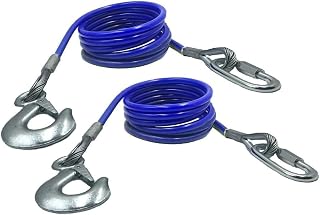
WLL 451268 provides a higher overall capacity with two 68-inch cables capable of handling up to 12,000 lbs per pair. This option is ideal for heavier trailers or situations requiring additional redundancy. Durable construction supports extended use in rugged conditions, and the pair design offers balanced pull.
Best for: Heavier loads or dual-cable setups where maximum strength and redundancy are desired.
Limitations: Longer cables may be less convenient for compact towing rigs; store properly to avoid dragging.
Trailer Safety Cables with S Hooks, 5000 lbs

This 2-pack offers 44″ and 79″ variants with a 5,000 lbs rating and vinyl-coated, rustproof steel. S-hooks with safety latches reduce decoupling risk, and the two-length option helps cover shorter or longer towing scenarios, including campers and utility trailers.
Best for: Campers or utility trailers where a compact solution is needed without compromising safety.
Limitations: Lower capacity than some 7 ft options; ensure your trailer loads do not exceed the limit.
Curt 80151 Safety Cable Assembly

The Curt 80151 assembly provides a dependable safety cable option with standard hooks suitable for general towing. It is designed for common tow setups and offers straightforward installation without the bulk of heavier, specialty cables.
Best for: General-purpose towing where simplicity and compatibility across multiple trailers are valued.
Limitations: May lack the extra-long reach or high-capacity features of heavy-duty models; verify fit for your specific hitch system.
Buying Guide
Key considerations help you match the right RV towing safety cables to your equipment and trips:
- Capacity and reach: Match the load rating to your trailer’s gross weight and desired slack control. Longer cables help in bigger rigs but may be heavier to manage.
- Construction and corrosion resistance: Galvanized or vinyl-coated steel resists weather and road salt, extending lifespan in RV parks and coastal routes.
- Design features: Coiled versus straight cables affect storage and ground clearance. Safety latches on hooks prevent accidental decoupling.
- Compatibility: Ensure the kit fits your tow system, hitch type, and vehicle. Some brands explicitly replace existing BX-series hooks or fit Class III setups.
- Storage and handling: Look for designs that stay off the ground and resist tangling for quick deployment on the road.
- Installation ease: Assembly-friendly models with clear hook engagement help reduce setup time during trips.
Frequently Asked Questions
- What is the typical length I should choose for an RV towing safety cable?
– Choose lengths that provide enough reach without excess slack; common options range from 4 feet to 7 feet depending on your trailer size. - Do safety cables require maintenance?
– Inspect for fraying, corrosion, or damaged hooks before every trip; replace if any wear is evident. - Are vinyl-coated hooks better than bare steel?
– Vinyl coating reduces ground wear and snag risk, and protects metal surfaces from rust. - Can I mix different brands of safety cables?
– It is best to use matching weight ratings and compatible hook types to maintain consistent safety performance. - What if my trailer is over 7,500 lbs?
– Look for higher-capacity cables or dual-cable setups that provide redundancy and greater load handling. - When should I replace a safety cable kit?
– Replace if the cable shows significant kinking, rust-through, fraying, or any compromised hooks or latches.