The best trouble code reader scanners quickly diagnose check engine lights, read live data, and clear codes across most 1996 and newer vehicles. This guide focuses on models suitable for DIYers, vehicle owners, and enthusiasts who want reliable, portable tools. Each product is evaluated for who it’s best for, plus clear pros and limitations to help you choose.
| Product | Best For | |
|---|---|---|
| ANCEL AD310 | Everyone, especially casual users | Simple, affordable, fast results |
| MOTOPOWER MP69033 | All OBD2 cars | Solid basics with broad compatibility |
| Innova 5210 | DIYers who want live data | Battery testing adds value |
| NETUM CS7501 | Inventory-style operations and off-network use | Versatile connectivity |
| FOXWELL NT301 | Regular diagnostic checks | Clear, actionable feedback |
Choosing the right tool depends on your needs: breadth of vehicle compatibility, ease of use, and what extra features matter most, such as live data, I/M readiness, or battery testing. The following sections summarize each option and explain who benefits most from each scanner.
ANCEL AD310 Classic Enhanced OBD II Scanner

The ANCEL AD310 is a compact, low-cost OBD II scanner designed to diagnose and clear emission-related codes quickly. It reads and clears diagnostic trouble codes, shows live data, and supports emission system monitoring. It is ideal for first-time users or a quick roadside check. It draws power directly from the vehicle’s OBDII connector, so no separate battery is needed. This model is best for weekend drivers who want fast, straightforward feedback without advanced features.
Best for: casual drivers and beginners who need fast, clear code results without extra friction. Why selected: lightweight, simple interface, and reliable basic troubleshooting help confirm issues before visiting a mechanic. Caution: may lack deeper live data and advanced test modes found on higher-end tools.
MOTOPOWER MP69033 OBD2 Scanner
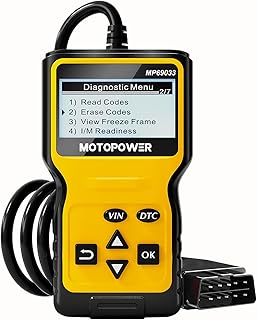
The MOTOPOWER MP69033 covers all OBD II protocols since 1996 and is designed for broad vehicle compatibility. It provides essential code reading and clearing capabilities and is suitable for drivers who want a reliable tool for multiple car makes. It’s a straightforward option when you need a dependable scanner without extra features that complicate operation.
Best for: owners with multiple vehicles or a preference for a simple, dependable tool. Why selected: broad protocol support, uncomplicated use, and dependable code handling. Caution: basic features may not include advanced live data customization or Bluetooth connectivity in some models.
INNOVA 5210 OBD2 Scanner & Engine Code Reader

The INNOVA 5210 combines OBD2 scanning with a battery tester, enabling alternator health checks and emissions readiness assessments. It offers live data and a drive cycle readiness feature to help ensure a vehicle is prepared for inspections. This makes it a strong choice for motorists who want more than just code reading and for those who perform routine maintenance planning.
Best for: DIYers who want both engine diagnostics and battery health insight. Why selected: adds battery testing to standard scanning, aiding preventative maintenance. Caution: coverage may vary by vehicle, so check compatibility with your car model before relying on battery results.
NETUM CS7501 QR Code Scanner

Note: The NETUM CS7501 is a QR code and barcode scanner rather than a vehicle OBD scanner. If you are looking for auto diagnostics, this model is not suitable. It is included here as a reference for buyers who may also need versatile scanning capabilities in a single device for inventory or general scanning tasks. Its strengths lie in 3-in-1 connectivity and high-resolution barcode reading.
Best for: buyers who need a portable barcode scanner for various business tasks, not car diagnostics. Why selected: versatile connectivity options and high-quality 2D/1D scanning. Caution: not an automotive OBD diagnostic tool; do not use for vehicle codes.
FOXWELL NT301 OBD2 Scanner

The FOXWELL NT301 is a professional-grade OBD2 scanner designed for quick checks and a clear read of engine fault codes. It provides one-click access to I/M readiness checks and uses dedicated indicators to communicate pass/fail status. Built for DIYers who want reliable, repeatable results, NT301 emphasizes fast diagnostics and straightforward verification of repairs. It is suitable for regular maintenance checks and pre-inspection readiness.
Best for: DIY enthusiasts seeking fast, reliable fault-code reading with clear I/M readiness indicators. Why selected: strong emphasis on accuracy for engine fault codes, plus user-friendly feedback. Caution: some advanced features may require occasional software updates or fuller coverage checks for certain makes.
Buying Guide: How to Choose Your Code Reader
What should you consider when selecting a trouble code reader? Start with compatibility, features, and ease of use. The best choice depends on your vehicle lineup, the type of diagnostics you perform, and whether you value extra tools like battery testing or live data streams.
- Vehicle compatibility: Confirm the scanner supports your make, model year, and OBD protocol. Some scanners work best with US, Asian, or European vehicles; others claim broad compatibility.
- Core capabilities: Basic code reading/clearing is essential, but live data, freeze frame, and I/M readiness can save time during inspections. Battery testing adds practical value for maintenance planning.
- Ease of use: Look for intuitive menus, clear results, and robust build quality. A compact design with a clear display minimizes guesswork in dim engine bays.
- Power source: Most OBD2 scanners draw power from the vehicle—no extra batteries needed. Some models offer offline modes or rechargeable options, but most rely on the car’s power.
- Data interpretation: Some scanners provide more context with codes and suggested fixes. If you prefer straightforward explanations, choose a model with concise, common-code definitions.
- Future-proofing: If you expect to diagnostic newer vehicles, verify support for recent emission standards and ongoing software updates when available.
Frequently Asked Questions
- What is an OBD2 scanner used for?
- Do I need a car-specific scanner?
- Can a scanner read live data?
- Is battery testing important in a code reader?
- How accurate are these scanners?
- Do these scanners replace a mechanic?
It reads diagnostic trouble codes from a vehicle’s onboard computer, helps identify issues causing the check engine light, and may clear codes after repairs.
Most 1996 and newer vehicles use the universal OBD2 protocol. A universal scanner works on a broad range of models, but always verify compatibility with your vehicle.
Many scanners provide live data streams such as RPM, engine temperature, and sensor readings. This helps diagnose issues beyond just fault codes.
Battery or alternator testing helps anticipate starting issues and electrical problems, making it a valuable feature on some models.
Accuracy depends on the device, the vehicle, and the connection quality. Higher-end models typically offer more reliable data and clearer diagnostics.
No. They help identify issues and verify repairs, but complex problems or mechanical failures may still require professional service.