Looking for a universal car diagnostic scanner that’s easy to use, reliable, and compatible with most vehicles? This guide reviews five top options that cover common needs—from quick check engine light codes to more in-depth live data and readiness checks. Each pick suits different buyer types: DIY homeowners, weekend wrenchers, and casual car owners who want fast, clear insights without dealer visits. The table below highlights the standout choices and who they’re best for.
| Product | Brand | Best For | Key Benefit |
|---|---|---|---|
| ANCEL AD310 Classic Enhanced Universal OBD II Scanner | ANCEL | Homeowners On A Budget | Fast, simple code reading and clearing; compact, durable design |
| MOTOPOWER MP69033 Car OBD2 Scanner | MOTOPOWER | All Vehicles With 1996+ Protocols | Broad protocol support and clear LCD display |
| VDIAGTOOL VD10 OBD2 Scanner | VDIAGTOOL | DIYers Who Want Detailed DTC Lookup | Large built-in code library with definitions |
| ANCEL AD410 Enhanced OBD2 Scanner | ANCEL | Comprehensive Emissions Diagnostics | Broad OBDII functionality with EVAP and O2 tests |
| FOXWELL NT604 Elite OBD2 Scanner | FOXWELL | Multi-System Diagnostics | 5-in-1 tool including ABS/SRS/transmission alongside ECU |
ANCEL AD310 Classic Enhanced Universal OBD II Scanner

The AD310 is a compact, entry-level OBD2 scanner that reads and clears emission-related codes, displays live data, and shows freeze frame information. It powers directly from the vehicle, with a straightforward interface designed for quick problem identification. Best for: homeowners and new DIYers who want a dependable tool for basic code retrieval and clearing without extra features. Limitation: it lacks broader system diagnostics beyond engine-related codes and may not support advanced live data for all vehicles.
- Key strengths: Fast results, clear display, rugged build with a 2.5-foot cable.
- Best use case: Quick check-engine-light troubleshooting on most 1996+ OBD2 vehicles.
MOTOPOWER MP69033 Car OBD2 Scanner

The MP69033 offers broad protocol support and a color LCD for easier interpretation of data. It covers 1996 US-based, 2000 EU-based, and Asian cars, including newer CAN vehicles. Best for: users who want a single scanner that handles multiple vehicle origins and languages. Limitation: Does not include advanced ABS/SRS features beyond basic engine data; users needing multi-system diagnostics should consider a more comprehensive model.
- Key strengths: Wide protocol compatibility, clear 2.8″ display, plug-and-play power from OBDII port.
- Best use case: Quick code read/erase and data stream for everyday vehicles.
VDIAGTOOL VD10 OBD2 Scanner
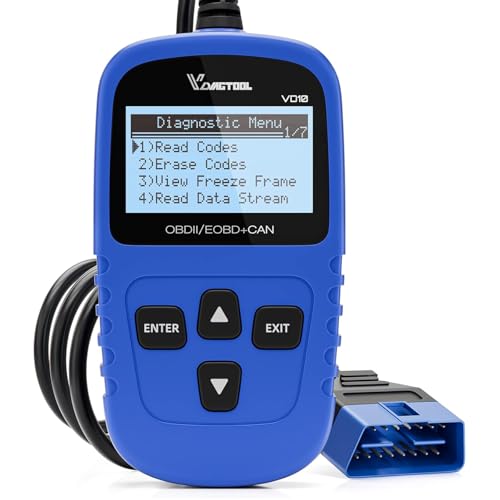
The VD10 is designed for DIYers who want a practical tool with a built-in database of DTC definitions. It reads and clears codes, displays live data and freeze frame, and checks I/M readiness. Best for: hobbyists seeking quick fault code explanations on-screen without internet searches. Limitation: While it has a robust code library, it may not offer extensive ABS/SRS diagnostics or EVAP testing on all models.
- Key strengths: Large, user-friendly display; quick access to DTC definitions.
- Best use case: Routine troubleshooting and emissions readiness checks.
ANCEL AD410 Enhanced OBD2 Scanner

The AD410 provides enhanced OBDII diagnostics with quick read and clear capabilities, including EVAP and O2 sensor tests. It is powered directly via the OBDII port and does not require an external battery. Best for: users who want deeper emissions-related insight beyond basic engine codes. Limitation: The AD410 is described as an engine-focused tool and does not support certain systems like ABS, SRS, or transmission in all cases; verify model compatibility before purchase.
- Key strengths: 42,000+ built-in DTC lookups; EVAP testing and O2 sensor evaluation.
- Best use case: Emissions-focused diagnostics and proactive engine health monitoring.
FOXWELL NT604 Elite OBD2 Scanner

The NT604 Elite is a robust, 5-in-1 diagnostic tool that covers ABS, SRS, transmission, and engine. It ships with updated software and an out-of-box ready experience, making it suitable for car owners who want a single device for multiple systems. Best for: those who want an all-in-one scanner for frequent checks across multiple vehicle subsystems. Limitation: The device is diagnostic-only; it cannot perform repairs or resets beyond clearing fault codes when the underlying issue is fixed.
- Key strengths: ABS/SRS/transmission coverage; live data and data playback with print options.
- Best use case: Multi-system health checks and preventative diagnostics.
Buying Guide: Key Purchase Considerations
- Vehicle compatibility: Ensure the scanner supports your vehicle’s year range and whether it uses CAN or older protocols.
- Systems covered: If you only need engine codes, a basic OBD2 reader may suffice. For multi-system diagnostics, select models that include ABS, SRS, and transmission.
- Live data and definitions: A built-in DTC library helps you interpret codes quickly; live data streaming aids in diagnosing running conditions.
- User experience: Look for a clear display, intuitive menus, and languages you understand; devices powered from the OBDII port are convenient.
- Future-proofing: Some scanners offer free firmware updates or expandable features; consider models that stay current with newer vehicle protocols.
Frequently Asked Questions
- What does a universal car diagnostic scanner do? It reads and clears trouble codes, shows live data, and helps identify the root cause of check engine lights across many vehicles that use OBDII protocols.
- Do these scanners require an internet connection? Most do not require internet; many rely on onboard DTC databases, while some offer online updates for new codes.
- Can I use a scanner on multiple cars? Yes, most OBD2 scanners are designed to work with any 1996+ vehicle that supports OBDII, but check protocol coverage for each car.
- Is it better to choose a multi-system scanner or a basic engine scanner? A multi-system scanner provides broader diagnostics (ABS, SRS, transmission), while a basic engine scanner is simpler and often cheaper for quick engine code checks.
- Will using these tools fix my car? Scanners diagnose issues but do not repair them. They guide you toward the underlying repair needed to clear codes responsibly.
- Do any devices require battery power? Most OBD2 scanners draw power from the vehicle’s OBDII port; some may have optional battery-powered options, but it’s not common.