If you’re wiring a trailer, RV, or towable camper, a reliable 7-way trailer wiring tester is essential for quick, accurate diagnostics. This guide highlights user-friendly testers that help you verify taillights, brake lights, turn signals, backup lights, and 12V power. The top picks are best for DIY tow vehicle owners, RV enthusiasts, and professional trailer technicians who want clear LED indicators, easy plug-and-play setup, and durable designs. Below, you’ll find concise product sections, a quick comparison table, and practical buying advice to help you choose with confidence.
| Product | Brand | Best For | Why It Stands Out |
|---|---|---|---|
| NeaLia 7 Pin Trailer Plug Tester | NeaLia | All-round testing for RVs and trucks | 180° rotatable head and quick 30-second test |
| Oyviny 7 Pin Trailer Plug Tester & 4 Pin Tester | Oyviny | Combined 4- and 7-pin testing | Double-sided LED indicators for readability |
| CURT 58272 7-Pin RV Blade Tester | CURT | Simple, ergonomic trailer testing | Easy LED-readout with two-side grips |
| CXTM Trailer Light Tester 7 Pin | CXTM | Versatile, plug-and-play testing | Clear LED indicators and six light functions |
| NEW SUN Quick Connect 7-Pin Trailer Tester | NEW SUN | Plug-and-play with durable build | Nylon body, high-conductivity terminals |
NeaLia 7 Pin Trailer Plug Tester

Best for quick diagnostics on RVs and towing setups. This tester consolidates seven signals—tail marker, brake, backup, left turn, right turn, stop, and 12V auxiliary—into a single plug-and-play unit. It features a standard 7-way connector and a 180° rotatable head to adapt to different socket angles. The compact design makes it ideal for frequent travelers and installers who need fast results and easy storage.
Who it’s best for: RV owners, pickup truck owners, and tow-ready trailer users who value speed and simplicity. Why selected: The 30-second test and rotatable head minimize fiddling and misreads in tight spaces. Caution: Some sockets in older trailers may require manual alignment after rotation for optimal indicator visibility.
Oyviny 7 Pin Trailer Plug Tester & 4 Pin Tester

This 2-in-1 tester combines a 7-pin blade and a 4-pin tester with dual-sided LED indicators for easy readability. It’s designed to troubleshoot trailer wiring quickly and verify proper installation. Note: It does not work with vehicles that have a lamp-out sensor. Best for users who own both 4- and 7-pin connections and want a single tool for multiple configurations.
Who it’s best for: Owners of mixed trailer fleets or vehicles with frequent connector swaps. Why selected: The dual-sided LEDs reduce misreading, and the 6-light function set covers essential trailer lighting needs. Caution: Not compatible with lamp-out sensor-equipped vehicles or some newer diagnostic systems.
Oyviny 7 Way Blade & 4 Pin Tester

This 2-in-1 tester pairs a 7-way blade with a 4-pin tester, supporting six lighting functions plus 12V power. It’s easy to use and quick to verify taillights, brake lights, turn signals, and more. However, buyers should be aware of model-year caveats, such as potential misalignment on some late-model Ford/GMC/Chevy vehicles. Best for: Mixed trailer setups where both blade and flat connectors are common. Why selected: Strong versatility and compact design. Caution: May test inaccurately on some 2017+ models; not suitable for vehicles with lamp-out sensors.
CURT 58272 7-Pin RV Blade Tester

CURT’s tester is designed for straightforward verification of taillights, brake lights, reverse lights, turn signals, electric trailer brakes, and auxiliary power. It uses LEDs to indicate good signals, and its ergonomic design includes two side grips for easy plugging and unplugging. Best for: Anyone who wants a simple, reliable indicator system with easy handling. Why selected: Clear LED feedback and grip-friendly design reduce fatigue during testing. Caution: Might require a helper to verify signal direction from the driver’s seat.
OPT7 7 Pin & 4 Pin Circuit Tester

OPT7 offers a 7-pin and 4-pin circuit tester with six LEDs to indicate each function: left turn, right turn, tail lights, brakes, reverse lights, and 12V auxiliary power. It emphasizes quick testing, with a compact 5.3″ long design. Best for: Users who frequently switch between 7- and 4-pin connectors and want explicit LED labeling. Why selected: The six-function LED indicators aid fast troubleshooting. Caution: Not compatible with LED lighting systems or lamp-out sensors on certain vehicles.
CXTM Trailer Light Tester 7 Pin
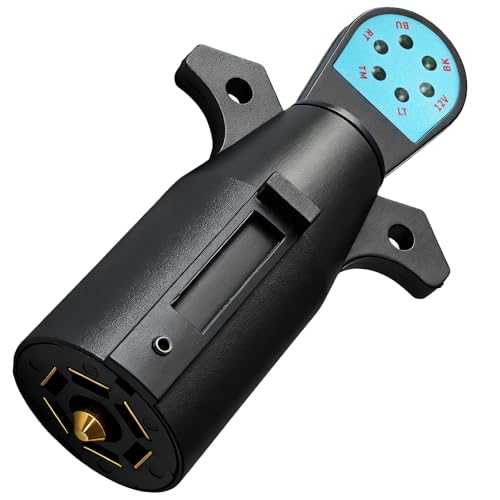
CXTM’s tester focuses on seven-way testing with seven indicators that cover tail, right/left turn, brake, and more. It’s designed for plug-and-play ease, with clearly labeled LEDs for quick reading. Best for: DIY enthusiasts who want a straightforward diagnostic tool with readable indicators. Why selected: Bright LEDs and an intuitive interface minimize guesswork. Caution: Some users may find it less effective on vehicles with newer LED configurations or sensor systems.
NEW SUN Quick Connect 7-Pin Tester

NEW SUN’s 7-pin tester emphasizes fast plug-and-play setup and a durable nylon body with copper terminals. It tests multiple functions, including taillights, brake control output, reverse circuits, turn signals, and 12V power. Best for: Road-travelers and professional installers who value long-term durability and quick installation. Why selected: A rugged build and broad testing capability make it a reliable all-purpose tester. Caution: Some users report upside-down indicator orientation on specific vehicle models.
Buying Guide
Key purchase considerations help you select the right 7-way trailer tester for your needs. Consider connector type, readability, and durability as primary factors.
- Connector compatibility: Ensure the tester supports your trailer’s seven-pin blade or RV blade configurations and matches your vehicle’s socket design.
- Indicator clarity: LED indicators should be easy to read in daylight and at night. Dual-sided LEDs are an advantage for easy reading from different angles.
- Ease of use: Plug-and-play devices save time. Look for rotatable heads or ergonomic grips, which help with tight or awkward sockets.
- Function coverage: A tester should clearly verify taillights, brake lights, reverse lights, turn signals, electric brakes, and 12V auxiliary power. Some models also indicate a “lamp-out” sensor compatibility note.
- Durability: Nylon or rugged housing, weather resistance, and robust terminals extend the tester’s life for frequent outdoor use.
- Vehicle compatibility caveats: Some testers may not work with vehicles equipped with lamp-out sensors or with certain LED-only lighting systems. Check model notes for such limitations.
FAQ
- What is a 7-pin trailer tester used for?
It tests all critical trailer lighting functions and auxiliary power to ensure safe towing and compliance with road rules.
- Can these testers work with both 7-pin and 4-pin connectors?
Some models combine 4-pin and 7-pin testing in one unit, while others specialize in 7-pin only. Check product notes for compatibility.
- Do LED indicators always reflect real-time function?
Yes, when the tester is properly connected, the LEDs show which circuits are active or faulty.
- Are there vehicles these testers cannot test?
Some vehicles with lamp-out sensors or LED-only systems may not be fully compatible. Review model limitations before purchase.
- Is plug-and-play truly tool-free?
For most testers, yes; you plug into the vehicle socket and read the LEDs without disassembly or external power.
- What’s a quick way to read LED indicators in bright sunlight?
Choose testers with high-contrast LEDs and consider models with dual-sided indicators designed for easier visibility.