Facing coolant leaks, overheating, or blown head gasket symptoms? This guide compares top cylinder head stop leak products to help you choose the right option. The list focuses on products designed to seal blown head gaskets, cracked heads, and related cooling system leaks, with emphasis on practical use for everyday drivers, fleet vehicles, and DIY enthusiasts. Below is a quick summary table of the selected products to help you compare at a glance.
| Product | Best For | Notes |
|---|---|---|
| Bar’s Leaks HG-1 Head Seal | Sealing warped/cracked heads and gaskets | Works with heavy-duty leaks; catch potential limitations with severe damage |
| K-Seal ST5501 Multi-Purpose | General coolant leaks; one-step convenience | Mixes with all antifreeze; no flushing required |
| K-Seal ST3501 Head Gasket Sealer | Blown head gaskets and engine block leaks | 16 oz pour-and-go format |
| Bar’s Leaks 1100 Head Gasket Repair Sealant | Permanent sealer for heads and gaskets | 20 oz bottle; reliable formulation |
| Bar’s Leaks 1109 Liquid Copper Block Seal | Radiator and coolant system leaks | 1-step, safe for all cooling systems |
Bar’s Leaks HG-1 HEAD SEAL Blown Head Gasket Repair

Best for: DIYers facing suspected blown head gaskets or warped heads who want a one-step fix. This product is designed to seal leaks in head gaskets, intake gaskets, and related areas to stop coolant loss and overheating. Use when the goal is a straightforward, field-ready repair without extensive disassembly.
Why selected: It targets common failure points in engines and offers a practical, ready-to-use approach for sealing leaks. It is most effective when leaks are within the pressure range the formula can manage and before the issue progresses to severe engine damage.
Caution: If the engine has heavy, ongoing coolant loss or significant mechanical damage, a professional inspection is advised as sealant effectiveness can vary with leak type and location.
K-Seal ST5501 Multi-Purpose One Step Coolant Leak Repair

Best for: Vehicles with a mix of small leaks across the cooling system and antifreeze-compatible needs. This is a versatile option for those seeking a single, no-flush treatment that works with existing coolant.
Why selected: Its one-step formula is designed to circulate through the system and seal both minor head and gasket leaks and radiator connections, making it a practical first-line fix for intermittent leaks.
Caution: Performance depends on leak size and location. It is not a substitute for major engine damage or non-cooling-system failures.
K-Seal ST3501 Pour & Go Head Gasket Sealer

Best for: Users dealing with blown head gaskets or cracked heads and engine blocks where a robust, 16-ounce pour-and-go solution is preferred. Suitable for older or higher-mileage engines where a sealant is a practical repair step.
Why selected: The larger volume provides extended reach for sealing leaks across critical areas, and the product is designed to work with common cooling system materials.
Caution: Like all sealants, success depends on leak characteristics and engine condition. It is not a guaranteed fix for severe mechanical failures or extensive cracks.
Bar’s Leaks 1100 Head Gasket Repair Sealant

Best for: Those seeking a robust head gasket repair sealant to address coolant loss and gasket leaks with a non-flush approach. Aimed at compact to mid-size engines commonly found in passenger cars and light trucks.
Why selected: It is widely used for head gasket leak repairs and is formulated to seal multiple potential leak points within the cooling system.
Caution: Effectiveness can vary based on engine design and leak severity. In persistent overheating conditions, additional diagnostics may be required.
Bar’s Leaks 1109 Liquid Copper Block Seal
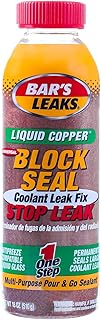
Best for: Radiator and coolant-system leaks where a copper-based sealant is preferred for quick control of coolant loss. Suitable for a range of cooling systems, including aluminum and cast iron components.
Why selected: The liquid copper formulation is designed for rapid sealing and compatibility with standard antifreeze mixes, helping to restore coolant integrity in a single step.
Caution: Copper-based sealants may not be ideal for all engine materials. Follow product directions for the best results and ensure compatibility with your coolant type.
Buying Guide: How To Choose The Right Cylinder Head Stop Leak
What type of leak are you addressing? The best option depends on leak location (head gasket, intake gasket, block, radiator) and the severity. For minor to moderate leaks, one-step, pour-and-go formulas save time. For gasket or crack-related failures, stronger, longer-lasting sealants may be required, but recognition of engine condition is essential.
Key considerations
- Leak location and severity: Determine where the leak originates and whether it’s a minor seep or major loss.
- Compatibility: Check antifreeze compatibility and material compatibility (aluminum, cast iron, plastics).
- One-step vs. multi-step: One-step formulas simplify the process; multi-step may offer more robust sealing in tougher cases.
- Engine type and age: Older engines with obvious gasket wear may respond differently than newer models.
- System preparation: Some products require no draining; others may benefit from a flush prior to application.
- Follow-up monitoring: After application, monitor for further leaks and address root causes if leaks persist.
Choosing by scenario
- Light leaks in everyday commuting vehicles: Consider ST5501 or HG-1 for quick sealing and return to service.
- Blown head gasket or cracked head: ST3501 provides a higher-volume option, while HG-1 targets gasket seals specifically.
- Radiator or block leaks: Liquid copper block seal is designed for rapid control in cooling systems with copper or mixed materials.
- Full system compatibility: Look for products explicitly stating antifreeze compatibility and materials compatibility.
Application tips
- Read and follow directions carefully to avoid unintended consequences.
- Ensure the engine is cool before opening the cooling system.
- Avoid driving at high speeds or heavy loads immediately after application; allow the product to circulate fully.
Frequently Asked Questions
- Q: Can stop-leak products permanently fix a blown head gasket?
- A: They are designed to seal leaks temporarily or as a stopgap; serious engine damage often requires professional repair or replacement, depending on the extent of the damage.
- Q: Do these products require draining the cooling system?
- A: Some are no-drain formulations; others may require baseline coolant flushing. Always follow the product instructions.
- Q: Are stop-leak products compatible with all antifreeze brands?
- A: Most are compatible with common antifreeze types, but always verify compatibility on the product label.
- Q: Can a stop-leak solution fix a cracked engine block?
- A: Sealants can sometimes seal small cracks, but larger cracks or structural failures typically require more extensive repair or replacement.
- Q: What are signs of successful sealing after application?
- A: Reduced coolant loss, stabilization of temperature, and absence of new leaks around the affected area.