When you need fast, actionable engine diagnostics, a handheld OBD2 scanner is your best ally. This guide highlights five reliable tools that cover common needs—from quick code reading and clearing to live data insights. Ideal buyers include DIY enthusiasts, car owners who want to understand CEL issues, and weekend mechanics seeking portable, battery-free options. The table below compares each product’s focus to help you choose quickly.
| Product | Brand | Best For |
|---|---|---|
| ANCEL AD310 Classic Enhanced Universal OBD II Scanner | ANCEL Store | Fast code reading and clearing for most 1996+ vehicles |
| MOTOPOWER MP69033 Car OBD2 Scanner | MOTOPOWER Store | Multi-language display and broad protocol support |
| FOXWELL NT301 OBD2 Scanner | FOXWELL Store | Professional-level diagnostics with I/M readiness |
| ANCEL AD410 Enhanced OBD2 Scanner | ANCEL Store | Deeper live data and OBDII diagnostics for beginners |
| VDIAGTOOL VD10 OBD2 Scanner | VDIAGTOOL Store | Budget-friendly, clear code definitions with freeze frame |
ANCEL AD310 Classic Enhanced Universal OBD II Scanner

The AD310 is a compact, budget-friendly OBD2 scanner that reads and clears engine fault codes for most 1996+ vehicles. It highlights CAI features such as a large display, clearly labeled buttons, and a device that powers directly from the vehicle, avoiding battery needs. It supports live data, freeze frame, I/M readiness, and memory data for emissions systems. This model is best for quick checks and straightforward fault code reading, making it ideal for DIYers who want a simple, portable tool. A potential limitation is that it may not provide deeper factory-specific data on all modern vehicles.
Best for: DIYers who want a reliable, no-frills tool for fast fault code reading and clearing in everyday cars. It’s also suitable for beginners needing clear results without extra setup. Choose this if you need a compact, easy-to-use scanner with direct power from the vehicle.
Limitation to note: Advanced, vehicle-specific data may be limited compared with higher-end models.
MOTOPOWER MP69033 Car OBD2 Scanner
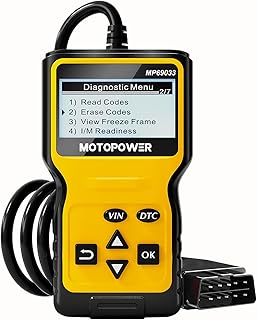
The MP69033 offers broad protocol support (9 protocols) and a color LCD with backlight, plus a built-in DTC lookup library. It reads and erases codes, shows live data, freeze frame, I/M readiness, and vehicle information. It’s a practical all-rounder for cars manufactured since 1996 and can display data in six languages. This tool is best for multilingual users and those who want quick, visual data on a readable screen. A limitation is the lack of a rechargeable battery, relying on vehicle power through the OBDII port.
Best for: Car owners who need a wide language selection and a clear LCD display for ongoing diagnostics on a diverse fleet. Opt for this if you value broad protocol support and easy interpretation of live data.
Caution: Ensure your vehicle supports the specific OBDII protocol in use; some older or highly specialized vehicles may have limited compatibility.
FOXWELL NT301 OBD2 Scanner

The NT301 is positioned as a professional-level tool for DIYers who want more than basic code reading. It reads and clears DTCs, provides I/M readiness status, and offers audible feedback. Features like one-click CEL clearing after repair and a dedicated I/M readiness indicator simplify the inspection process. It is best for users who want confidence before testing in the shop or at the inspection station. A potential drawback is that its advanced features may be more than needed for casual users.
Best for: DIYers who seek a reliable, quick-acting diagnostic with reliable I/M readiness checks and a clear pass/fail signal before road testing. Choose this if you want professional-like feedback without a professional price tag.
Caution: The device should be used to verify repairs; erasing codes before the underlying issue is fixed can mask problems temporarily.
ANCEL AD410 Enhanced OBD2 Scanner

The AD410 expands on basic scanning with 42,000+ built-in DTC lookups, live data streams, and comprehensive OBDII functionality—reading/clearing codes, live data, freeze frame, I/M readiness, O2 and EVAP tests, and vehicle information. It provides more depth for beginners who are ready to learn diagnostics and for those who want to communicate more precisely with technicians. The device is well-suited for users who want ongoing, practical diagnostic support without visiting a shop. A limitation is that it may be slightly more complex than entry-level models.
Best for: Beginners advancing beyond basic scans, who want broader diagnostic coverage and helpful live data to guide repairs. Choose this if you want a single tool that covers more tests and data types.
Caution: More features mean a steeper learning curve for absolute beginners.
VDIAGTOOL VD10 OBD2 Scanner

The VD10 appeals to budget-conscious buyers who still want meaningful code definitions and functions like read/clear codes, live data, and I/M readiness. It provides a large database of DTC definitions (more than 3000 codes) on the TFT screen, helping users diagnose root causes without online lookups. It is best for casual DIYs who want straightforward results and quick code clarity. A potential limitation is that it has fewer advanced features than higher-priced models.
Best for: Cost-conscious owners who want a dependable, easy-to-use tool with clear on-screen code definitions and basic live data capabilities. Avoid this if you need extensive advanced tests or EVAP/O2 sensor tests beyond basic read/clear.
Buying Guide: How to Choose Your Handheld Engine Diagnostic Tool
What’s your primary use?
If you just need quick check engine light (CEL) responses, choose a simple code reader like the AD310. For ongoing maintenance or more complex diagnostics, look at AD410 or NT301 for live data and broader tests.
Do you need live data?
Live data helps you diagnose trends and performance issues. AD410 and NT301 offer strong live data options, while AD310 provides basic live data in most cases.
How important is language and readability?
MP69033 supports six languages and a large LCD, which helps users who prefer non-English interfaces. If bilingual support matters, this is a good pick.
Is budget a key factor?
VD10 targets budget buyers with essential functions and extensive DTC definitions. If you want depth without breaking the bank, this can be the best balance.
Compatibility and coverage
All models support most OBDII-compliant vehicles, but performance can vary by year, make, and model. For older vehicles, ensure the scanner supports your specific protocol. For newer cars, prefer models with broader OBDII tests like EVAP, O2, and freeze frame data.
Ease of use
Look for clear displays, intuitive menus, and one-click features (like one-click CEL resets). This reduces the learning curve for first-time users and speeds up troubleshooting.
Frequently Asked Questions
- What is a handheld engine diagnostic tool used for?
- Can I rely on these tools for complex repairs?
- Do these tools work with my specific vehicle?
- Is a rechargeable battery needed?
- Will clearing codes erase data?
- Which scanner offers the best value?
It reads and clears diagnostic trouble codes, displays live data, and helps determine the condition of a vehicle’s engine and emissions systems.
They provide guidance and data but are not a substitute for professional diagnostics on complex issues or safety-critical systems.
Most OBD2 scanners work with 1996+ US-based, EU-based, and many Asian vehicles. Always check protocol compatibility for your model year and region.
Most options in this guide power directly from the vehicle via the OBDII port, avoiding the need for separate batteries or chargers.
Clearing codes removes the CEL. If the underlying problem isn’t fixed, the codes can return when the issue recurs.
Value depends on needs: for quick checks, AD310; for richer data and more tests, NT301 or AD410; for budget-conscious buyers, VD10.