Answer: For effective headliner insulation, choose a lightweight, closed-cell foam or butyl-based mat that offers heat resistance and strong sound dampening. The best options suit different vehicle interiors, budgets, and installation preferences. This guide highlights five top picks ideal for car headliner insulation, clarifying who each product is best for and why it was selected.
Buyer’s quick reference table
| Product | Best For | Key Benefit |
|---|---|---|
| Siless Liner 157 | Budget-conscious DIYers | Lightweight 4 mm closed-cell foam, easy to cut |
| KILMAT 80 mil | High-dampening needs | Thicker, great noise reduction |
| Storystore 394mil | Heavy-duty, larger projects | Fire & water resistance, strong adhesive |
| Second Skin Heat Wave Pro | Premium headliner insulation | Jute with reinforced foil for heat reflection |
| KILMAT 50 mil | Balanced performance | Moderate thickness with solid dampening |
Siless Liner 157 (4 mm) Car Sound Deadening

Best for budget-minded projects where easy handling matters. The Siless liner is a 4 mm closed-cell PE foam that acts as both a sound deadener and heat barrier. It’s lightweight and simple to cut to fit irregular headliner shapes, making it suitable for first-time installers or those tackling smaller headliner sections. Best for: DIY enthusiasts who want a straightforward, affordable solution without heavy installation steps. Limitation: May provide less dampening compared with thicker or butyl-based mats in very loud cabins.
KILMAT 50 mil Car Sound Deadening Mat

Choose this for a balanced approach to headliner insulation. The 50 mil thickness offers a good mix of ease of installation and effective noise reduction. It suits mid-range projects where a reliable dampening layer is preferred without the bulk of thicker options. Best for: semi-premium builds or when upgrading multiple panels with consistent results. Caution: For very loud cabins or extreme heat, you might want thicker material for improved performance.
Storystore 394mil Car Sound Deadening Mat
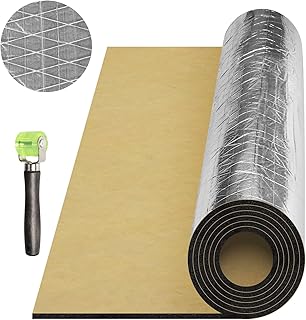
This is a heavy-duty option with high thickness (394 mil) and strong self-adhesive features. It’s best for projects requiring substantial dampening, such as fully headliner replacements or vehicles with persistent road and engine noise. Best for: larger areas or louder cabins where maximum noise reduction is needed. Limitation: Bulkier to work with and may require more careful trimming and compression during installation.
Second Skin Heat Wave Pro – Jute with Foil

Top-tier headliner insulation featuring jute fibers paired with reinforced foil. This combo aims to reflect heat away from the cabin while delivering strong sound dampening. Best for: premium installations where heat management is a priority, such as vehicles in hot climates or spaces requiring substantial thermal control. Caution: This option is heavier and may require more substantial surface preparation for best adhesion.
KILMAT 80 mil Car Sound Deadening Mat

Heavier than the 50 mil option, the 80 mil version provides higher dampening for louder vehicles or larger areas. It’s best for users who want a robust layer of sound reduction without moving to full butyl-based systems. Best for: drivers seeking stronger performance with a thinner profile than the thickest mats. Limitation: May require more careful cutting and alignment on curved headliner surfaces.
Buying Guide: Key Considerations for Headliner Insulation
- What thickness do you need? Thicker mats (e.g., 80 mil to 394 mil) generally offer better dampening but add weight and may be harder to fit on curved surfaces. Choose based on noise levels and headliner contours.
- Closed-cell foam vs. butyl-based materials: Closed-cell foams are lightweight and easy to install, good for light to moderate dampening. Butyl mats provide stronger noise reduction, especially for louder cabins, but can be heavier and trickier to install.
- Heat management: For hot climates or vehicles with exposed heat sources, consider products with heat barriers or foil layers to reflect heat away from the cabin.
- Adhesion and surface prep: Proper cleaning, degreasing, and dry fit are essential. Strong adhesive backings simplify installation, but ensure surfaces are smooth for best coverage.
- Project scope: If headliner replacement is part of a larger interior refresh, thinner mats might suffice for the headliner while thicker mats can be used on doors and floors for comprehensive damping.
- Cutting and fit: Look for products that are easy to cut and shape to match contours of the vehicle’s headliner. Pre-scored patterns or easy-to-slice sheets help.
Frequently Asked Questions
- What is headliner insulation best for? It improves interior acoustics by reducing road and engine noise transmitted through the roof, and it can help manage heat in some climates.
- Can I install insulation on curved headliners? Yes, but some mats are easier to shape. Use utility scissors or a sharp knife and small patches to cover curved areas without gaps.
- Is thicker always better for headliner dampening? Not always. Thicker mats provide more dampening but add weight and can be harder to install on tight curves; balance performance with fit.
- Do these mats require professional installation? Not necessarily. Many kits are designed for DIY installation with basic tools, but complex interiors may benefit from professional help.
- Will insulation affect headliner lighting or airbags? Generally no, if installed properly. Ensure no interference with sensor housings, airbags, or wiring during trimming and placement.
- How long does installation typically take? For a simple headliner, a few hours is common; larger projects or full interior dampening can take longer depending on preparation and curing time for adhesives.