Finding a reliable tire pressure gauge is essential for safe riding and optimal tire life. This guide highlights five top picks that suit different riders—from casual bikers to precision-oriented racers. Each option is chosen for durability, readability, and compatibility with common valve types. The top picks cover mechanical and digital gauges, plus a portable inflator with a built-in gauge. If you ride a motorcycle, car, or bike, these gauges help you maintain correct pressures for better handling and efficiency.
| Product | Type | Best For |
|---|---|---|
| PUIBERS Mechanical Tire Gauge | Mechanical, 60 PSI | Riders who want a durable, battery-free gauge with glow-in-the-dark readability |
| JACO ElitePro Digital Tire Pressure Gauge | Digital, 0-100 PSI | Riders seeking high accuracy and quick digital readings |
| Counteract MKPG-D Analog Gauge | Analog, 5-50 PSI | Riders needing a compact, rugged option with a 90-degree head |
| AstroAI Digital Tire Pressure Gauge | Digital, 0-150 PSI | General use for cars, motorcycles, and trucks with ANSI-grade accuracy |
| AstroAI L7 Tire Inflator | Inflator with gauge, 150 PSI | On-the-go inflation with a built-in display and LED illumination |
PUIBERS Mechanical Tire Gauge 60 PSI

The PUIBERS gauge is a mechanical option featuring a bronze bourdon tube and durable brass construction. It operates without batteries and claims ANSI Grade B40.1-level accuracy for reliable readings. The glow-in-the-dark dial improves readability in low light. A patented flexible hose and a 90-degree right-angle chuck are designed to reach awkward motorcycle valves easily. Best for motorcycle, car, and bike owners who want a rugged, low-maintenance tool with clear visibility in dim conditions. Caution: while durable, it may require occasional recalibration to maintain peak accuracy over years of use.
JACO ElitePro Digital Tire Pressure Gauge

The JACO ElitePro is a digital gauge known for professional-grade accuracy up to 100 PSI. Its design emphasizes quick, clear digital readings, making it a strong choice for riders who want precise numbers at a glance. Best for riders who prioritize speed and data visibility, especially those who regularly switch between motorcycles and other vehicles. A potential limitation is that digital displays can be affected by extreme temperatures or battery-related issues, though this model typically minimizes concerns with robust construction.
Counteract MKPG-D Analog Tire Gauge
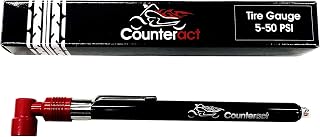
The Counteract MKPG-D provides a compact, all-metal design with a 5-50 PSI readout and a 90-degree head for hard-to-reach valves. It’s a solid option for motorcycles and ATVs where space is tight and durability matters. Best for riders who want a reliable, simple analog gauge that can withstand rougher environments. Limitations include a narrower pressure range compared to some digital models, so it may be less suitable for high-pressure applications on certain vehicles.
AstroAI Digital Tire Pressure Gauge

The AstroAI digital gauge measures up to 150 PSI with ±1 PSI accuracy, offering versatility for cars, motorcycles, and trucks. It aligns well with ANSI B40.7 standards and features a user-friendly LCD display for quick readings. Best for riders who want consistent precision and a device that works across multiple vehicle types. A possible caveat is that digital accuracy can be sensitive to temperature changes, and battery maintenance is required to prevent readout issues.
AstroAI L7 Tire Inflator With Gauge
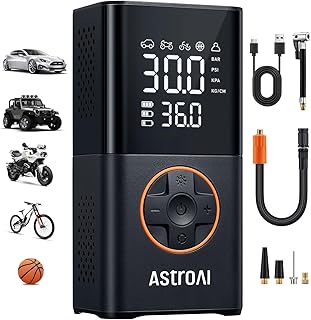
The AstroAI L7 combines a 150 PSI inflator with a built-in digital gauge, providing fast inflation and a clear display. It includes an auto shut-off feature, a compact form factor, and an LED light for nighttime use. Best for riders who want an all-in-one tool that inflates and measures pressure on the go. The limitation is that the integrated inflator may be bulkier than standalone gauges, which could affect portability for some riders.
Buying Guide: Key Considerations For Tire Pressure Gauges
- Gauge Type: Choose mechanical for battery-free reliability or digital for quick, precise readings and easy data capture.
- Pressure Range: Match the gauge to your vehicle’s typical tire pressures. Motorcycles often require lower ranges (5-60 PSI) while cars and trucks may exceed 100 PSI.
- Readability: Look for glow-in-the-dark dials or backlit displays for night riding and dim conditions.
- Valve Compatibility: Ensure the gauge has a compatible chuck angle (90-degree heads are helpful for hard-to-reach stems).
- Durability: All-metal construction resists drops and exposure to elements, a common scenario in garage or roadside use.
- Portability: Consider weight and size if you carry a gauge as part of a toolkit or glove box kit.
- Accuracy Standards: ANSI-grade certifications indicate adherence to established accuracy norms and can guide selection.
- Maintenance: Digital gauges may require battery changes; mechanical gauges require occasional calibration checks.
Frequently Asked Questions
- What is the advantage of a mechanical gauge over a digital one?
Mechanical gauges do not require batteries, can be more durable in tough environments, and often have long-term reliability. - How do I know which PSI range I need for my motorcycle tires?
Check the vehicle’s owner manual or tire placard; motorcycles commonly use lower PSI ranges, while heavier bikes or dual-sport tires may require higher readings. - Are digital gauges more accurate than analog gauges?
Accuracy depends on the model and calibration. Digital gauges can be very precise, but high-quality analog gauges are also reliable when properly maintained. - Can I use the same gauge for cars and motorcycles?
Yes, provided the gauge’s pressure range covers both vehicle types and the valve compatibility is suitable for both stems. - What maintenance helps extend gauge life?
Keep the gauge clean, protect it from moisture, recalibrate if needed, and replace batteries promptly in digital models. - Is a built-in inflator worth it for travel use?
An inflator with a gauge adds convenience for on-the-go adjustments, though it may be bulkier than standalone gauges.